
11 August 2026

What if a trek could leave you with more questions than answers? What if, after days of trekking, you reach a lake filled with centuries-old human skeletons? For years, the mention of Roopkund stirred the imagination of trekkers around the world. In the Garhwal Himalayas, this glacial lake earned international fame not only for its alpine appearance but also for the hundreds of ancient human skeletons scattered along its shores. Nicknamed the Skeleton Lake, Roopkund became one of India's most mysterious trekking destinations and a place where adventure, history, folklore, and science converged.
If you’ve been following the story of the Roopkund Trek, you may remember that its future became uncertain after a landmark 2018 Uttarakhand High Court order. The court banned overnight stays in the state’s fragile alpine meadows and placed restrictions on visitor numbers, citing concerns over damage to the delicate bugyal ecosystem. Years of increasing trekking activity, littering, soil erosion and pressure on the meadows had raised serious questions about how much tourism these landscapes could withstand.
For trekkers, the decision meant that one of Uttarakhand’s most loving trails was no longer as accessible as it once was. The closure also showed trekkers that the Himalayas are not just adventure destinations, they are living ecosystems that need care. But now, after years of uncertainty, there is a new chapter in the story. In July 2026, the Supreme Court changed some of the earlier restrictions, including the ban on overnight stays in bugyals and the limit of 200 visitors. This has opened the door for trekking activity to resume, with the required permissions and regulations still in place.

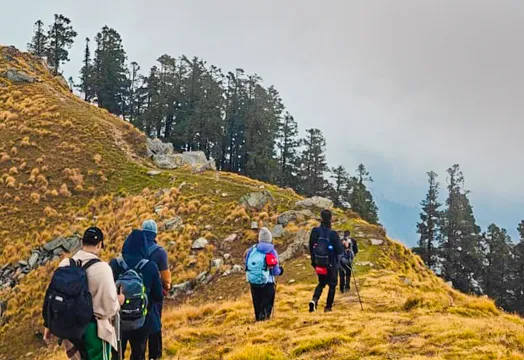
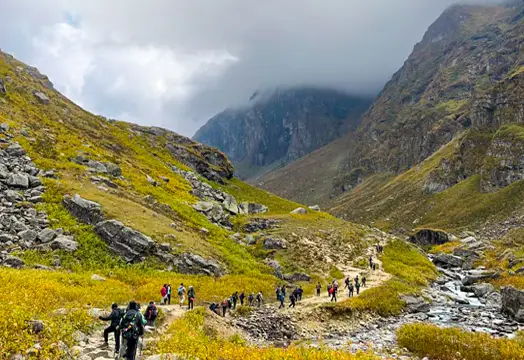
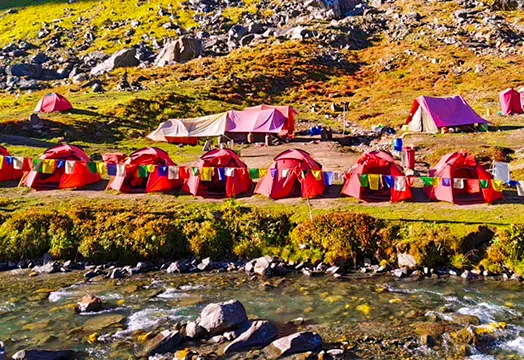
The Roopkund Trek is as much about the places where you camp as it is about the trail itself. Campsites such as Didna Village, Ali Bugyal, and Bedni Bugyal bring a different side of the Himalayas into view as the trail climbs higher.
At Didna Village, the setting is still close to mountain life, with sunflower fields and forest huts. Further along, Ali and Bedni Bugyal bring you into the high-altitude meadows. The forests fall away and the jaw dropping green slopes take over. Camping here gives you a chance to experience the mountains with pure bliss.

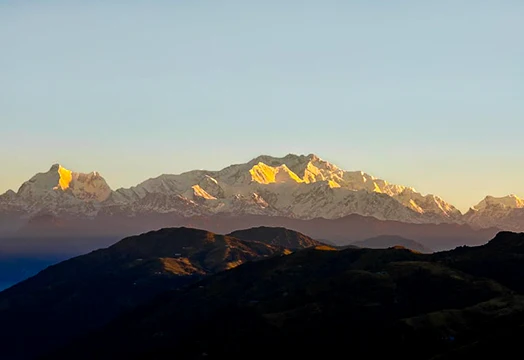
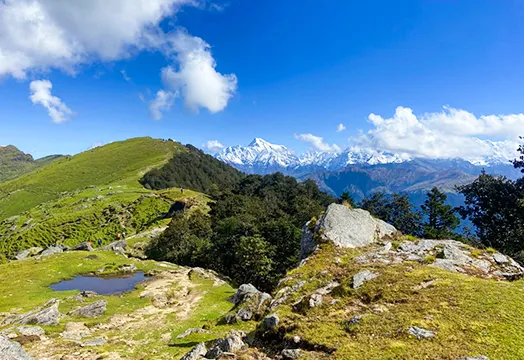
Some views are so grand that you must see them with your own eyes to believe they are real. You might know the names of famous peaks like Mt. Trishul, Nanda Ghunti, Chaukhamba, Hathi Parvat, Gauri Parvat, Kedarnath, and Gangotri. But, seeing them up close on this trek will amaze you.
These peaks appear on other trekking routes as well, but Roopkund gives you a different view. It feels as if a massive circle of frozen glaciers and snowy ridges is surrounding you from every side. You will find yourself looking up into the sky, breathing in the freezing air, and wondering if you are dreaming!?
Additionally on the way, trekkers cross Kalu Vinayak, where they especially stop by the black stone idol of Ganesha. And from this particular place the rougher, steeper sections begin and yet trekkers push forward for what lies ahead, where the final secret waits, the skeleton lake!
The sight here is strange and striking! You can look straight down into the clear, turquoise water and see the ancient bones scattered right where you stand. Skeletons lie along the rocky shoreline, kept intact by the freezing temperatures. It is an intense, spine-chilling moment where time stands still, and you are left staring directly into history!

The Roopkund trail is not just known for its mysterious lake; it is also connected to one of the most important cultural traditions of Uttarakhand, the Nanda Devi Raj Jat Yatra. For centuries, these mountains have been considered sacred by local communities who worship Goddess Nanda Devi, the patron goddess of the Garhwal and Kumaon regions. The pilgrimage is a journey of faith and devotion for the mountains.
Held once every 12 years, the Nanda Devi Raj Jat Yatra is also described as the “Himalayan Kumbh Mela” because of its scale and spiritual importance. Thousands of devotees walk on the challenging mountain trails, crossing forests, rivers, and high-altitude meadows to reach the sacred highlands associated with the goddess. Locals believe that Nanda Devi is the protector of the mountains, and the pilgrimage is a way of seeking her blessings. Many sections of this route pass through the same landscapes seen on the Roopkund trek. These old paths have been used by pilgrims for generations, long before trekking became popular in the Himalayas.
Long before science arrived with instruments, local folklore held its own explanation for the hundreds of human remains scattered at the lake. The legend tells of an ancient ruler, Raja Jasdhaval, who traveled up the pass with a lavish royal entourage. By ignoring the sacred purity of the mountains, he triggered the wrath of the goddess Nanda Devi, who summoned a catastrophic storm to wipe out the entire party.
Modern forensics has shown that the ancient myth shares a terrifying alignment with reality. A 2004 investigation examined the skulls and revealed unhealed perimortem fractures caused by large, rounded objects striking the victims from directly above. Science concluded that in the 9th century, a large group of people was indeed caught exposed on the ridge and perished under a sudden, devastating barrage of massive hailstones.

Just when researchers believed they were beginning to understand the mystery of Roopkund, another discovery changed everything. The question that had fascinated explorers for decades became even more complex when scientists turned to modern genetic research to study the remains preserved around the lake.
DNA analysis published in 2019 revealed that the skeletons at Roopkund did not belong to a single group of people or even the same historical period. Earlier assumptions suggested that all the individuals may have died during one tragic event, but genetic evidence painted a far more complicated picture. The remains belonged to different groups who arrived at the lake centuries apart. Some individuals were found to date back to around the 9th century, while others belonged to a much later period, nearly a thousand years afterward.
The most surprising discovery was that not everyone found at Roopkund shared the same ancestry. While many individuals had genetic links to South Asian populations, several others showed ancestry connected to the Eastern Mediterranean region, including areas associated with present-day Greece.
This discovery raised more questions than it answered. How did people from such distant lands reach a remote Himalayan lake located at an altitude of nearly 15,750 ft? Were they travellers, pilgrims, traders, or part of an unknown journey that history never recorded? Why did people from different parts of the world end up at the same isolated mountain lake? Despite years of research, no clear explanation has yet emerged. Roopkund continues to remain one of the Himalayas' greatest mysteries and a place where mythology, archaeology, and science meet, leaving behind more questions than answers!

Most treks give you one reason to remember them like a peak, a view, a sunrise. But when we say Roopkund, it gives you several, stacked on top of each other: meadows that feel endless, a wonder of Himalayan peaks, a living pilgrimage route, and a mystery that science still hasn't fully cracked. Few trails anywhere in the world combine landscape, history, and the genuinely unexplained like this one, which is why, even after everything that's been written about it, Roopkund still manages to surprise everyone who walks there.
Note: Trek with Humility
As this high-altitude ecosystem is incredibly fragile, standing on this trail requires environmental respect. Over decades of popularity, the trail suffered heavily from commercialisation and littering, which signifies how easily human footprint can disturb nature and history.
To experience a legendary trail like Roopkund is a privilege, not a right. It demands that we act as guardians of the landscape. True adventurers must commit to a strict Zero-Waste Policy, packing out every scrap of trash, keeping the sacred glacial waters pure, and staying strictly to the designated paths. By trekking with absolute humility and treating the mountain like a temple, we all can ensure that the mysteries and unparalleled beauty of the Skeleton Lake remain preserved for generations to come.
Must Read Articles for Trekkers:
Best Treks To Experience During Autumn Season
Guide to Altitude Sickness: AMS, HAPE & HACE Symptoms and Prevention
11 August 2026

Trek updates, stories & mountain insights.
Tips and insights for every trekker.
11 Oct 2026

10 Oct 2026
09 Oct 2026
08 Oct 2026
07 Oct 2026
06 Oct 2026
05 Oct 2026
04 Oct 2026
03 Oct 2026
01 Oct 2026
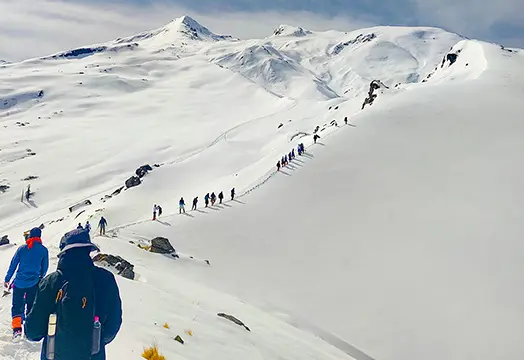
Every season in the Himalayas has its own way of showing off the mountains, but winter reveals a different side of them, one that feels like a whole new world.
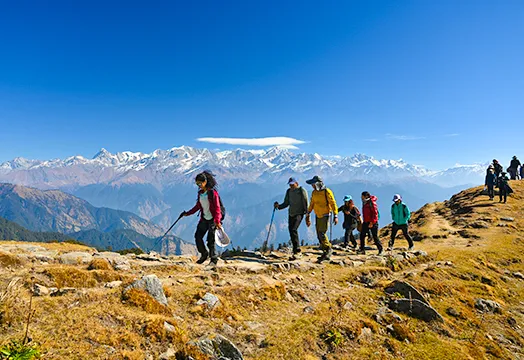
As monsoon season comes to an end, it washes away all the dust and haze that remains in the valleys throughout the summer, and then?
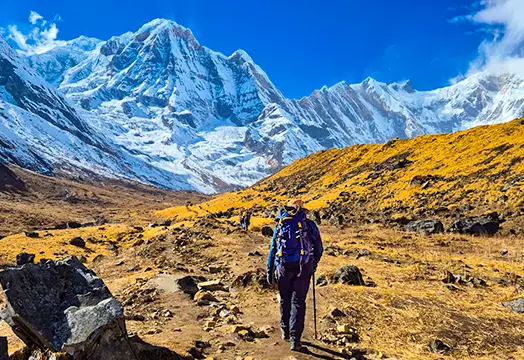
Located in north-central Nepal's Gandaki Province, Annapurna is the world's 10th highest and one of the most challenging mountains on the planet. Its height rises to 26,545 feet. Yet reaching Annapurna base camp is a far more accessible adventure, drawing trekkers from around the world every single season.
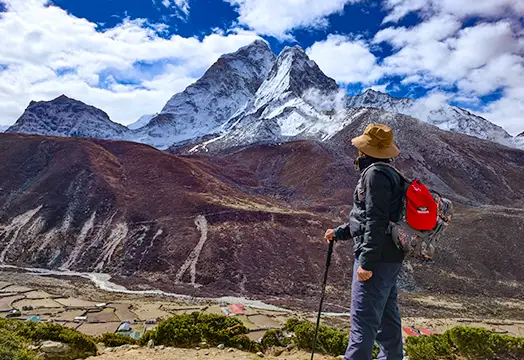
What does it feel like to stand on a trail where the mountain before you is worshipped as a goddess? For most of us, it's an adventure. But for the local communities who live in its shadow, it's something closer to faith. That mountain is Everest.

Over the last few decades, trekking has driven a profound shift: rural economies and local communities are reaping direct and indirect benefits.

Hiking teaches you to fall in love with the outdoors. Trekking teaches you to endure it. Mountaineering teaches you to respect it completely.

There are only a handful of Himalayan regions that hold profound spiritual significance as well as immense natural beauty. The Gaumukh Tapovan trek is one such destination that wonderfully combines adventure, divinity, and extraordinary Himalayan beauty.

What if a trek could leave you with more questions than answers? What if, after days of trekking, you reach a lake filled with centuries-old human skeletons?

Every year, every season reveals a new side of the Himalayan range. Be it trails covered in colourful rhododendrons or trails transformed into a lush green paradise, each season offers some of the most mesmerizing views of the Himalayas.

Altitude sickness is a physical reaction that occurs when you climb faster than what your body can adapt, especially in regions where air pressure and availability of oxygen tends to drop.