


Duration
7 Days

Age
08 to 16 years

Region
Uttarakhand

Pickup Details
Dehradun Office

Safety First
24/7 emergency support

Guidance
Experienced Trek Leaders
About the Programme
Summer, and All the Fun It Brings!As summer comes, the most awaited time for kids comes too. The Holidayyys..! No matter how much they enjoy being with their friends at school, the excitement and wait for the holidays is always a never-ending topic.
To make this summer even more exciting, Summit Scholars Himalayan Summer Camp 2026 is here to turn holidays into an adventure to remember!
This programme is a 7-day, completely outdoor-based and screen-free experience that is designed for children aged 8-16 years. Over the course of the week, children will explore the mountains, play fun games, engage in activities, enjoy creative sessions, and experience the joy of trekking, all in a safe and carefully planned environment. Parents can choose between two specially selected treks: Kedarkantha or Dayara Bugyal. Both are beginner-friendly treks and perfect for young adventurers.

What is an Outdoor Summer Camp Adventure?

The Outdoor Summer Camp Adventure is more than just a regular summer camp! It is a camp under the open sky, walking through trails, exploring himalayas, life skills, nature and more. We conduct our camp in a completely natural setting among the mountains so that kids can build social connections, play, explore, and learn life skills through trekking and camping in a safe, fun, and inspiring environment.
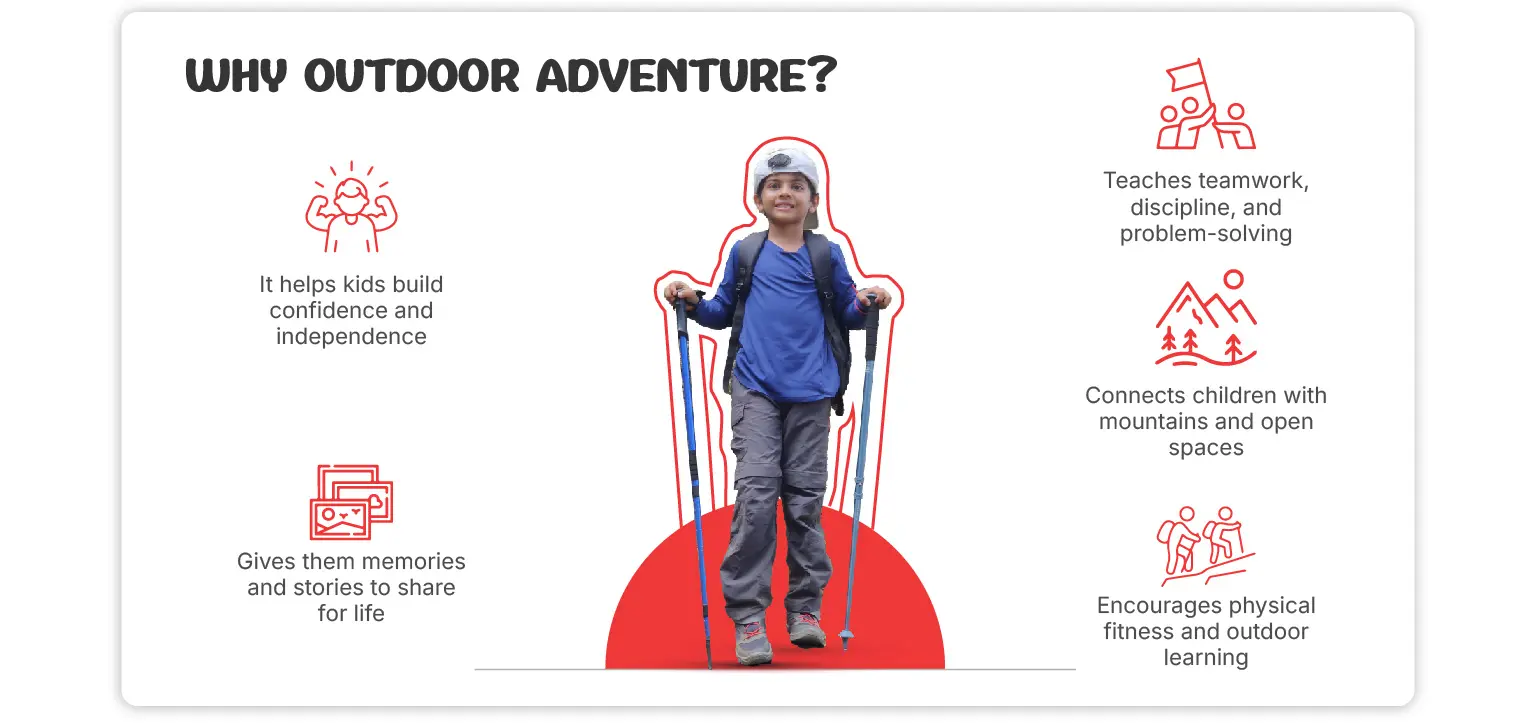
Why is a Summer Camp Experience Essential for every Child?

Parents! If we think back to our school time, summer season was definitely the most wonderful time of the year, and why not—summer comes with all the happiness a kid waits for.
If we think a little more deeply, we remember it was a special time when we as kids would visit grandparents’ homes often. Things were different back then, but the excitement is still the same.
This time, do you think a summer camp could be a good choice? But as always, there is a twist. This time, an Outdoor Summer Camp could be an excellent and superb choice!
A summer camp is a good choice, whereas an outdoor camp is 3X better. How? Let’s see what we have kept this time in a box full of surprises!

The Fun
The Learning

This time an Outdoor Summer Camp!
The main aim of this summer camp filled with outdoor adventure is to develop self-discipline and empathy in every kid throughout the camp. If you have never sent your child to an outdoor summer camp or a Himalayan trek, it can feel like a big decision. But such a camp is more than a fun trip—it is a safe space where children learn, grow, and discover new things about themselves.
At an Outdoor Camp, children experience threefold growth as they move out of their familiar surroundings! No parents, no siblings, no daily routine—this becomes their first step toward independence.
Being in the mountains gives them a chance to explore a world far away from screens. They run through open meadows, see the Himalayas up close, and experience life in a tent under the stars while learning small survival skills.
This year with our “Summit Scholars Himalayan Summer Camp”, your child can grow in self-care, communication, creativity, and environmental awareness—all while enjoying a real outdoor adventure.
Telescope Specifications: Dobsonian GSO 6-inch – ideal for observing the Moon and planets, as well as nebulae and distant galaxies.
Activities That Your Child Will Do in the Summer Camp
Every year children look forward to summer camp for fun activities, exciting games, and little challenges that spark curiosity. In our Summit Scholars Himalayan Summer Camp, children will be engaged in exciting activities that keep them active, curious, happy, and learning new skills.
The activities are divided into three main parts.

Skill Building Activities
- 1.Map Reading
- 2.Navigation Skills
- 3.Basic First-aid Skills
- 4.Find It Fast!
- 5.Where’s That Point?

Nature-Based Activities
- 1.Nature Doodles
- 2.Stargazing
- 3.Bird Watching
- 4.Identifying Plants / Animals / Insects
- 5.Environmental Education
- 6.Nature Journaling
- 7.Valley Crossing

Team Building Activities
- Tug-a-thon
- Grab the Gold
- Group Reflection
- Recreational Activities
The camp is packed with games like:

Find It Fast!
How to Play:
2 teams search for listed items around the camp. The team that finds all or the most items first wins. Teams must stick together and work as one.
What Kids Will Learn:
- Teamwork, observation, time management, communication
Real-life Benefits:
Builds cooperation, problem-solving skills, patience, and decision-making confidence
Find the Ideal Trek for Your Child
Choosing the right trek for your child can make a big difference in their overall experience. Dayara Bugyal and Kedarkantha are two of the most popular choices for kids’ first Himalayan adventures.
Dayara Bugyal Trek

Dayara Bugyal is one of the best options if your child likes open fields, walks and loves to observe things and enjoy the scenery.
The path is not complicated and thus it is suitable when it comes to first time trekkers. The walk over its broad meadow is like walking into a different world, and the experience makes them feel safe and confident gradually.
Dayara is ideal for children aged 8-13 years who love to explore the mountains serenely. 8-13 years

Itineraries
- 1
Day 1: Arrival at Dehradun and Drive to Base Camp (Natin Village)
- Altitude: 2,200 m / 7,200 ft
- Highlight of the Day: Distribution of the Welcome Kit
- 2
Day 2: Acclimatization and Team Building at Base Camp
- Altitude: 2,200 m / 7,200 ft
- Highlight of the Day: Star Gazing, Valley Crossing
- 3
Day 3: Trek to Gui (Camp 1)
- Altitude: 3,000 m / 9,800 ft
- Highlight of the Day: Nature Doodles, Environmental Education, Map Reading, Tug-a-thon
- 4
Day 4: Trek to Chilapada (Camp 2)
- Altitude: 3,300 m / 10,500 ft
- Highlight of the Day: Navigation Skills, Basic First-Aid Skills, Bird Watching
- 5
Day 5: Summit Day - Dayara Top and Trek to Nayata
- Altitude: Dayara Top (3,700 m / 12,000 ft), Nayata Campsite (2,800 m / 9,200 ft)
- Highlight of the Day: Recreational Activities, Nature Journaling, Grab the Gold, Where's that Point?
- 6
Day 6: Return to Base Camp and Celebration Night
- Altitude: Natin Village (2,200 m / 7,200 ft)
- Highlight of the Day: Group Reflection, Certificate Ceremony, Musical Night and Performances, Gala Dinner
- 7
Day 7: Departure to Dehradun
- Highlight of the Day: Return journey begins, wake-up call at 6:30 AM, followed by a shared experience session at 7:30 AM, departure from Natin at 8:30 AM, and finally reach Dehradun at around 4:00 PM.

How We Ensure the Safety and Security of Your Child
We know how careful parents are, and safety is the major thing they first think about when sending their children anywhere. Especially when it comes to some outdoor activities, it is natural to have concerns, and that's perfectly okay.
At Trek The Himalayas (TTH), we are proud to be recognized as the Safest and Trusted Adventure Provider in India. For over a decade, thousands of trekkers and families have chosen us for our focus on safety, professionalism, and well-organized treks. This trust is our biggest responsibility and we never take any chances that could put your child’s safety at risk.
Daily Health Checkups
Our team performs regular health check ups in the morning and evening. This will assist us to monitor the well-being of all children and identify in time when one needs additional attention.
Trained Professionals
Each camp is supervised by certified trek leaders and camp staff professionals who are trained to handle children in the mountains and ensure a safe environment. Even our kitchen staff are also First Aid Responders. Every year, TTH conducts first aid training for all staff members, ensuring they are always prepared with the latest safety practices.
Emergency Services
When it comes to our Outdoor Summer Camp for children, we go above and beyond to ensure a safe experience. Our emergency preparedness is designed to handle any situation, no matter how small. Here’s how we take care of your child:
- Ambulances stationed at both base camps for immediate evacuation if needed
- Qualified doctors present at both base camps for quick medical attention
- Emergency kits at every campsite, well-stocked for minor injuries or common health issues
- A dedicated emergency response team always on standby throughout the trek
- Our trek leaders are also trained in First Aid, CPR, and Wilderness Emergency Response , which means they know exactly what to do in any critical situation. Each team carries a comprehensive medical kit, so help is never out of reach.
Female Trek Leader
To make sure all children feel comfortable, supported, and cared for, at least one female trek leader will be there on every summer camp batch.
GPS-Enabled Tracking Device
All our vehicles are GPS-enabled. This will ensure that the parents are always informed about their child’s location and movements during travel.
Parents can also directly connect with the trek coordinator if they have any questions or concerns.
Cost Terms
- Accommodation (as per itinerary)
- Guest house accommodation on Day 1, Day 2, and Day 6 on triple/quad sharing basis
- Camping accommodation during the trek from Day 3 to Day 5
- Meals (Vegetarian + Eggs)
- All meals from Dehradun to Dehradun
- Meals included from Day 1 breakfast to Day 7 lunch
- Support & Supervision
- 1 Base Camp Manager to handle coordination, communication, and emergency support
- 1 Mountaineering and First Aid–certified Trek Leader
- 1 Experienced high-altitude chef
- Local experienced guides (number as per group size)
- Adequate support staff throughout the trek
- 5:1 student-to-instructor ratio
- Trek & Camping Equipment
- Sleeping bags, sleeping liners (if required), mattresses, and utensils
- 3-man all-season trekking tents (twin sharing)
- Kitchen tent, dining tent, Medical tent and toilet tent
- Camping stools and walkie-talkies
- Safety equipment including ropes, helmets, ice axe, harness, gaiters, and microspikes (as required)
- Medical & Safety Support
- Comprehensive first aid, medical kit and stretcher
- Oxygen cylinder
- Blood pressure monitor, oximeter, stethoscope
- A qualified doctor stationed at the base camp
- Emergency evacuation transport kept on standby
- Transportation (as per itinerary)
- Dehradun to Dehradun transfers
- Local transfers from base camp to the trekking point
- Additional Services
- Cloakroom facility available at the base camp
- Mules/porters for carrying common and personal luggage (up to 10 kg per participant)
- All required permits and entry fees (as applicable for Indian nationals)
- Trek insurance (for Indian nationals)
- Trek completion certificate from Trek The Himalayas
What to Pack for Your Child – Complete Packing List
Packing right makes the trek experience smoother and more enjoyable for your child. Make sure that your child brings all of the mentioned items in the list in order to fully enjoy his time in the mountains.
In case you have any query regarding the items, you can contact our trek coordinator. Also, if you don't want to invest in buying all the clothing or gears, you can rent them as well from the TTH Rent-a-Gear for about one-tenth of the price.
 Gear & Essentials
- ItemsQty
- Regular Backpack / Duffle Bag with Enough space1
- Daypack (20–25 L)/ School Bag1
- Trekking shoes (Preferable) / Sports Shoes1 Pair
- Sandals/Floaters1 Pair
- Trekking poleAt least 1
- Head Torch with Extra batteries1
- Water bottle (1 L) (Provided by TTH)1
- Thermal bottle (1 L)1
- Tiffin Box (Provided by TTH)1
 Clothing
- ItemsQty
- Quick-dry/ Synthetic T-shirts3
- Woolen sweater or fleece jacket1
- Windcheater/Windstopper jacket1
- Padded Warm jacket1
- Thermal Inner (upper & lower)1 set
- Dry-fit/ Synthetic pants3
- Warm pants/ Thick Track Suit Pants1
- Regular socks6 pairs
- Woolen socks2 pair
 Accessories
- ItemsQty
- Sun cap1
- Woolen cap1
- Sunglasses1
- Neck gaiter/ Muffler1
- Hand gloves1 Pair
 Toiletries & Personal Care
- ItemsQty
- Toothbrush & toothpaste1 each
- Soap1
- Quick-dry towel1
- Toilet paper/ Biodegradable Wet Wipes1
- Moisturiser & sunscreen1 each
- Lip balm1
- Antibacterial powder1
- Hand sanitizer1
Your Child’s Meal Plan at Camp
At Trek the Himalayas, we ensure your child receives all the essential nutrition needed for a growing mind and an active body. Our dedicated team of nutritionists has carefully curated a well-balanced food menu specifically designed for young trekkers. Every meal is thoughtfully planned to match the physical activities and the demands of the specific trek your child will undertake.
Below is the complete food menu that your child will enjoy during the trek.
Want Your Child to Join the Trek? Here’s How to Book
We’ve made the booking process quick and hassle-free, so you can reserve a spot for your child in just a few easy steps. Here’s how:
- Visit the official “Summit Scholars Himalayan Summer Camp” webpage.
- Click on the “Book Now” tab — this will take you to the departure date selection section.
- Choose between the two trek options: Dayara Bugyal or Kedarkantha. Select the one you’d like your child to join.
- Pick the preferred month, and from the available dates, choose the one that works best for you.
- Fill in your contact information, followed by your child’s details — Name, Age, Date of Birth, T-shirt size, Address, and the chosen trek date.
- If you’re registering more than one child, click on “Add Participant” and enter their details as well.
- Review the payment summary, then proceed to make the payment.
- Once the payment is complete, your child’s trek is officially booked!
Important Notes for Parents
1. All the meals are included in the package, therefore, it's strictly prohibited to carry any packaged food in the camp as this harms the environment. We are dedicated to keeping our mountains clean and urge you to join us in this effort.
2. In case of an emergency where a child needs to be called back from the camp, our trek leader will bring the child safely back to the base camp. From there, a dedicated staff member will personally accompany the child all the way to Dehradun and hand them over to the parent/guardian. Please note: All expenses for travel and staff assistance will be borne by the parent or guardian.
Read About our No Volunteer Policy
When it comes to taking care of children in the mountains, we don’t take chances. At TTH, we follow a strict No Volunteer Policy.
We respect the passion and enthusiasm of volunteers, but when it comes to the safety of children, we choose to place them under the care of trained and experienced professionals. This way, we can make sure every child is guided by someone who understands mountain terrain, is skilled in handling children, and is trained in first aid and emergency response.
This approach ensures that your child is always under the guidance of people who can make quick, safe decisions in any situation. It gives parents peace of mind and children a structured, secure environment where they can enjoy and learn confidently.
Gallery
Glimpses of our work and the beautiful Himalayan landscape


Frequently Asked Questions (FAQ)
Find answers related to the summer camp

The Summit Scholars Himalayan Summer Camp is an outdoor adventure program crafted for children aged 8-16 years to give them an excellent experience in the Himalayas. The camp combines trekking, camping, and nature exploration with activities that teach essential life skills like teamwork, resilience, decision-making, and basic outdoor survival. Children get to connect with the natural environment, engage in fun group games, learn practical skills such as tent pitching, map reading, and first aid, and enjoy moments like stargazing and village walks. Every activity is planned to make learning enjoyable, helping children grow in confidence, independence, and a love for nature while having all the fun in the mountains.
The camps are held at two beautiful base locations in Uttarakhand: Natin for the Dayara Bugyal Summer Camp and Sankri for the Kedarkantha Summer Camp. Both treks are specially chosen for kids, as they are very beautiful and beginner-friendly treks for children. The locations provide a safe and natural environment where kids can learn, explore, and enjoy outdoor activities.
The camp is mainly for children aged 8–16 years. We have selected two treks for kids: Dayara Bugyal is suitable for ages 8–13 years, while Kedarkantha is ideal for ages 10–16 years.
The day begins around 6:AM with morning tea, followed by breakfast and health check up. All the days are designed differently with variant activities. The days are planned with trekking, and learning sessions. Sometimes the evenings are planned with stargazing, where other days include skill building sessions where kids learn outdoor skills like how to use a sleeping bag and basic first aid.
Around 5:30 PM, kids will enjoy evening soup and snacks. Morning and evening health check-up is constant to monitor every child’s well being. At 7:00 PM dinner is served and by 8:30 PM, kids settle into their tents for the night.
Children should pack all the important essentials like trekking shoes, warm layers, rain gear, comfortable trek pants, T-shirts, toiletries, reusable water bottles, and a backpack. We have made a packing list of all the important essentials, you can check it here: check here
We also have a rental option, if you don't prefer to buy all the clothing or gears. You can rent them from the TTH Rent-a-Gear section for about one-tenth of the price. Rental Gear Section link: Rent-a-Gear
Tents are assigned based on age and gender to make children feel comfortable and safe. Friends are grouped together whenever possible, but children are encouraged to interact and build new friendships.
These treks are very beginner-friendly and do not require any prior experience. Many children in the 8–16 age group often take part in these treks. Both the Dayara Bugyal and Kedarkantha treks are specially chosen for their easy routes and the extremely beautiful Himalayan experience.
The Summit Scholars Himalayan Summer Camp 2026 is designed with all the life skills and personal growth activities. Children will get a chance to explore the Himalayas through trekking and connecting with nature. They will play team games, learn outdoor skills like basic first aid, tent pitching, and camping techniques. All the activities are specially designed for kids so they can learn so many things just in excitement and while having fun.
Every child will learn new skills while having a lot of fun. Our main aim is to make sure learning happens naturally. With our designed activities and games, kids will learn teamwork, resilience, decision-making, and outdoor survival basics such as packing, pitching tents, and map reading.
Parents need not to worry about anything. Campsites are very secure, and all the safety protocols are followed. The instructors supervise all the children and activities, and kids follow a buddy system. We also have doctors available at the base camps and an emergency team throughout the trek. All activities are supervised, and children are never left unattended.
Children are supervised by trek leaders and instructors. We follow a ratio of 1 instructor for every 5 children. Instructors are trained in outdoor leadership, first aid, and child care. Female instructors are also present to support every kid, especially girls for comfort and support.
It’s normal for children to feel homesick, and we make sure our team is present there to provide comfort. Our team is trained to handle such situations with care. Children are encouraged to share their feelings, and our leaders engage them in fun activities, group games, and team-building exercises to help them feel comfortable and confident. Children adapt quickly and feel comfortable within the first couple of days.
All our trek leaders are certified in first aid and wilderness safety. A doctor is stationed at the base camp, and emergency transport is always ready if required. Each campsite has a dedicated medical tent, and first aid kits are available at all times. Our team is trained to handle minor injuries, altitude-related issues, or any emergencies promptly, so parents can be confident about their child’s well-being throughout the camp.
At base camps, children stay in guesthouses with separate arrangements for boys and girls. While on the trail, they share three-person expedition tents equipped with sleeping bags and liners.
TTH is first known for its safety and second for providing the most amazing food in the Himalayas. The meals are vegetarian, simple, and nutritious, including roti, dal, rice, and vegetables. We also have options for Jain and vegan food, which are available on request.
Yes, clean and safe water is provided at the base camps and along the trek routes. Children are also encouraged to carry reusable water bottles to stay hydrated throughout the day.
Parents can not join the children’s summer camp as the program is designed specifically for kids to develop independence, confidence, and social skills in an outdoor setting. However, parents can join our Family with Kids batches, which are specially designed programs where families can experience the adventure together while still enjoying age-appropriate activities for children.
₹ 21,000 /Per Child
+5% GST
+ Rs 300 Trek Insurance


