
27 August 2026

There are only a handful of Himalayan regions that hold profound spiritual significance as well as immense natural beauty. The Gaumukh Tapovan trek is one such destination that wonderfully combines adventure, divinity, and extraordinary Himalayan beauty. This spectacular journey traces the route of the river Ganga, going all the way up to its origin point.
Beginning at the sacred Gangotri, the trail leads through rugged valleys, rocky patches, untouched meadows, ancient glaciers, and dramatic high-altitude landscapes. The spotlight is Gaumukh, the impressive snout of the Gangotri Glacier and the legendary source of the Bhagirathi River.
Gaumukh refers to an awe-inspiring, snout-shaped, towering wall of ancient ice. As the imposing glacier rises before your eyes, the mighty Bhagirathi bursts from beneath with a roaring torrent.
Beyond it lies Tapovan, a breathtaking alpine meadow renowned for panoramic views of majestic peaks such as Shivling, Meru, and Bhagirathi. Ancient sages and monks are believed to have practised deep meditation and penance here. This is reflected in the name “Tapovan”—“Tap” meaning penance or spiritual austerity, and “Van” meaning forest.
The reason that the Gaumukh Tapovan trek is truly special is because it’s more than just a trek; it’s a journey into the birthplace of Ganga and into the heart of one of the spiritual epicentres of the Himalayas. For devotees as well as trekkers, walking this trail is not just a physical expedition. It’s a pilgrimage – a rare journey away from the usual world, toward a landscape deeply embedded in India’s culture.
The trek's greatest significance comes from its divine association with the River Ganga. Gaumukh literally means "cow's mouth" because it was historically perceived as resembling the mouth of a cow. This resemblance also carries cultural symbolism. In Hindu philosophy, the cow is regarded as sacred and is associated with nourishment, purity and abundance. Thus, the water coming out of a cow's mouth adds another layer of reverence to this place.
This emerging stream is traditionally regarded as the very foundational source of the Ganga, called Bhagirathi. In fact, down the stream at Devprayag, when Bhagirathi meets Alaknanda, the combined river takes the name Ganga.
This headstream of Ganga is way beyond being just a geographical feature. It is revered as a sacred and purifying mother with divine presence. Her waters have been central to Hindu worship, pilgrimage, and civilization for centuries. To stand at Gaumukh is to stand in a place with extraordinary spiritual resonance.
Gaumukh Tapovan is also special because it is connected with the ancient Char Dham Yatra Trail. Gangotri, being one of the four revered pilgrimage centres of Uttarakhand, is also the place where the earthly manifestation of Ganga took place. Even today, this journey represents a continuation of a tradition that was deeply embedded in the religious and cultural consciousness of India.
What makes this trek even more remarkable is that this sacred tradition hasn’t disappeared. Today, trekkers may walk these trails with modern equipment, but the fundamental attraction remains exceptionally similar to that of earlier generations. From this point of view, Gaumukh Tapovan is a living link between ancient pilgrimage and modern Himalayan exploration.

The word Tapovan is a combination of two Sanskrit words, Tapas and Vana. Tapas means meditation with intense spiritual penance, and Vana means forest or wilderness. Together, Tapovan can be understood as a "forest of meditation" or "forest of spiritual practice."
According to the traditional understanding, ancient sages (Rishis), monks, ascetics, and spiritual seekers came here to withdraw from worldly distractions and immerse themselves in profound meditation and contemplation. In the solitude of the Himalayas, they sought higher states of awareness and deeper metaphysical understanding.
Thus, Tapovan is not just the name of any Himalayan meadow. It basically invokes a true ancient idea of the wilderness as a place of complete spiritual transformation. It has always been known as a place where silence, austerity, contemplation, and atonement with nature were believed to be the pathways to transcendental knowledge.
Even the Pandavas were believed to have meditated in the caves of Tapovan after the war of the Mahabharata. Clearly, its remoteness, sacredness, and divine association offered precisely the conditions that were conducive to Tapasya —solitude, silence, austerity, simplicity and freedom from worldly distractions.
One more thing: the Gaumukh Tapovan trek can also be understood as an inner journey – from worldly desires to a higher self-awareness.
Therefore, this spiritual weightage adds another dimension to this trek. Visitors not just enter a beautiful alpine meadow landscape; they actually step into a world whose very identity has been shaped by centuries of spiritual evolution.
Apart from being a breathtaking alpine meadow, Tapovan’s another defining natural attraction is Mount Shivling standing in its backdrop. It’s one of the most recognizable peaks in the Indian Himalayas.
Its distinctive shape, steep rock faces and gleaming summit make it visually striking from other mountains. As it is associated with Lord Shiva, its unique form has long been interpreted through religious symbolism.
One of the most memorable moments at Tapovan is watching the first sunlight reach Mt Shivling. The mountain can gradually change colour as sunlight illuminates its rocky faces and snowy upper sections.

The detailed context of King Bhagirath bringing the Ganga to earth from the heavens is primarily found in the Valmiki Ramayana.
This story is narrated by Sage Vishvamitra to Lord Ram in the Bala Kanda of the Valmiki Ramayana. It’s a story about an unfinished duty that lingered across generations, about an extraordinary determination, and about the fulfilment of a dharma that even many great kings before Bhagirath could not accomplish.
This story begins well before Bhagirath, with a great king named Sagar. An ancestor of Ram and once a ruler of Ayodhya, Sagar was a righteous king, but he had no children. He therefore sought divine help for an heir. His two wives, Keshini and Sumati, eventually received different blessings: Keshini would have one son, while Sumati would have 60,000 sons.
Sagar later organized Ashvamedha Yajna. As part of this ritual, a selected horse was released to roam freely, and wherever it travelled, the king’s sovereignty and hegemony were asserted. But the horse mysteriously disappeared. And the king asked his 60,000 sons to search for it.
But to find the horse, they dug the whole earth, which turned out to be a tremendous excavation. Although they found the horse, they also encountered Sage Kapilla.
The sons wrongly suspected and accused Sage Kapilla of having taken the horse. And this was their fatal mistake. Being enraged by their behaviour, the sage burned the sons with his powerful spiritual energy, reducing them to ashes.
As King Sagar’s sons didn’t receive proper rites, there was then only one way to provide them spiritual release: the waters of Ganga must descend to earth and reach their ashes.
Generations later, through the same lineage, it was King Bhagirath who inherited this task of liberating Sagar’s sons. And he decided to accomplish what his ancestors could not. He swore to bring Ganga down.
Bhagirath then began an extraordinarily severe penance. According to Valmiki Ramayan, the intensity of his penance was striking. He controlled his senses, observed severe discipline, and sustained his Tapasya over a substantial period of time.
His entire existence revolved around this very objective. Eventually, his Tapasya pleased Lord Brahma, and he was ready to grant him his longstanding wish.
But then Brahmaji revealed a problem.
Ganga couldn’t simply fall from heaven to earth, as she was immensely powerful, and the earth couldn’t withstand that force.
Brahmaji told him that Lord Shiva was the only deity who could control the force of Ganga in his dreadlocks.
Now, this was the time to please Shiva. So, he performed another severe penance. And eventually, Shiva was pleased, and he agreed to bear the impact of Ganga's descent upon his head.
And the Ganga did fall, and Shiva did carry her fall. But then there was another problem – the mighty river disappeared as she got trapped within Shiva’s tangled hair.
Once again, Bhagiratha's mission seemed to have reached an impasse. But he never stopped to perform further austerities. Finally, Shiva released Ganga, and the celestial river began her journey across the earth.
Bhagirath walked ahead, and Ganga followed the path he took. At last, Bhagiratha arrived at the place where the ashes of Sagara's sixty thousand sons lay. As her sacred waters flowed over their ashes, the sons of Sagar were liberated.
Recognizing this profound feat, Brahmaji declared that Ganga would become associated with Bhagirath's achievement and would be known as Bhagirathi.
There is a deeper meaning to this story as told by Rishi Valmiki. Something fundamental and something universal.
The greatest achievement of Bhagirath didn’t come from armies, wealth, or power. He succeeded through Tapas.
He encountered obstacle after obstacle. Yet he fulfilled his inherited duty.
So, the story teaches that at every stage, perseverance is required. Bhagirath’s greatness lies not simply in the fact that he brought a river to earth. It lies in his refusal to abandon a sacred responsibility that had remained unfulfilled for generations.
The Gaumukh Tapovan trek is an extraordinary journey on many counts, as it offers a complete spiritual immersion along with incredible natural landscapes. Here are these highlights of Gaumukh Tapovan Trek:

Also considered the spiritual gateway to Uttarakhand’s pilgrimage destinations, Gangotri is one of the Char Dham venues. Here, you can visit the sacred Gangotri Temple and watch the Bhagirathi River flowing through. This place is among those few pilgrimage centers that offer a peaceful and godly atmosphere.
The trek passes through Gangotri National Park, a breathtaking wilderness in the Himalayas. Encompassing an area of approximately 1,553 sq km, the park houses coniferous forests, alpine meadows, glaciers and high-altitude habitats. This region is also home to multiple wildlife species, including bharal (blue sheep), Himalayan monal, Himalayan tahr, and musk deer.
It’s a stunningly beautiful stoppage on this route. The name Chirbasa is because of the blue pine forests found along this section of the trail. As you walk alongside the scenic Bhagirathi valley, the surrounding mountains and pine forests create a mesmerizing backdrop.
Bhojbasa is named after the Bhojpatra trees (Himalayan birch) that are found here. This campsite is another key attraction of the route. The transition of the scenery here is quite stark as the landscape becomes noticeably more barren, and the Himalayan peaks become increasingly prominent.

Being the source of the Bhagirathi River, Gaumukh is the central highlight of the trek. It’s the snout of the Gangotri Glacier, from where the Bhagirathi River emerges. The name "Gaumukh" literally means "cow's mouth". Standing before this massive glacier and watching frigid water emerge from the ice is an extraordinary experience.
Rising to approximately 6,550 m (21,500 ft), Mt Shivling is probably the most attractive feature of this trek. This peak has a striking, almost symmetrical shape and dominates the scenery around Tapovan. From the meadow, you can get an exceptionally close and breathtaking view of this peak.
Tapovan is probably the biggest reward of this journey. Nestled at around 4,450 m (14,600 ft), this captivating destination is basically a high-altitude alpine meadow embraced by some of the most spectacular peaks. This meadow is also known for its remarkable contrast – soft alpine grasslands with enormous, glaciated mountains in the backdrop.
Another prominent attraction is the Bhagirathi massif, consisting of the Bhagirathi I, II and III peaks. These mountains form an impressive wall of rock and snow around the upper Gangotri valley. One thing you can notice about these peaks is that their appearance changes throughout the day with moving sunlight.

The best time to do the Gaumukh Tapovan Trek is during two main windows: Summer (May - June) and Autumn (September - October). Actually, the trek involves steep sections, boulders, moraine, and glacial terrain, so choosing the right season becomes paramount, especially for beginners.
May to June: This period is ideal if you want:
September to October: Post-monsoon skies create an atmosphere where you see the views in full scale and detail. Don’t miss this period if you want:

Day 1: Drive from Dehradun to Gangotri
The journey from Dehradun to Gangotri goes through winding mountain roads, deep valleys and the Bhagirathi River, gradually guiding you into the high Himalayas.
Day 2: Acclimatization Day at Gangotri
Adjust to the altitude and soak in the spiritual and natural beauty of Gangotri. After breakfast, visit the revered Gangotri Temple, explore the local market, or immerse in the culture and atmosphere of this sacred valley.
Day 3: Trek from Gangotri to Chirbasa
The trail follows the Bhagirathi River through forest terrain and mountain slopes, gradually ascending towards the tranquil forests surrounding Chirbasa. It offers your first striking glimpses of the magnificent peaks.
Day 4: Trek from Chirbasa to Bhojbasa
This shorter but scenic trek takes you deeper into the high Himalayas, where the forest gradually thins, and the landscape showcases contrasting views. Here, the towering Bhagirathi massif begins to command the horizon.
Day 5: Trek from Bhojbasa to Tapovan
Today’s trek is challenging yet rewarding. Through rugged moraines, steep terrain, and cold mountain streams, you’ll make your way towards legendary Tapovan. The beauty of this alpine meadow is enhanced by the majestic Mt. Shivling.
Day 6: Trek from Tapovan to Bhojwasa via Gaumukh
The trail descends towards Gaumukh, the spectacular snout of the Gangotri Glacier and the original source of the Bhagirathi River. This journey offers a stark contrast of ice, rock, and moraine.
Day 7: Trek from Bhojwasa to Gangotri
The final trekking day retraces the imposing rocky trails, rugged terrain, high-altitude wilderness, and the beautiful Gangotri valley.
Day 8: Depart for Dehradun
The journey back to Dehradun takes you once again through the winding Himalayan roads, and you are expected to be back by 6 to 7 pm.
The Gaumukh Tapovan Trek is located at an altitude of 14,600 ft in the Garhwal Himalayas of Uttarakhand, within the Gangotri region. The trek begins at the sacred town of Gangotri and passes through Gangotri National Park, following the Bhagirathi River towards Gaumukh and then ascending to the high-altitude meadow of Tapovan.
Gaumukh is the glacial snout of the Gangotri Glacier, from which the Bhagirathi River emerges. It is therefore regarded as the physical source of the Bhagirathi, one of the principal headstreams of the Ganga. It becomes Ganga only when it meets Alaknanda at Devprayag.
Gaumukh literally means "cow's mouth." The name comes from the traditional belief that the opening of the Gangotri Glacier resembled the mouth of a cow. From this glacial opening, water emerges and forms the Bhagirathi River.
The Gaumukh Tapovan Trek is considered a moderate to difficult journey. It is considerably more demanding than a typical beginner-friendly trek because the route reaches around 4,450 m (14,600 ft) at Tapovan.
Must Read Articles for Trekkers:
Best Treks To Experience During Autumn Season
Guide to Altitude Sickness: AMS, HAPE & HACE Symptoms and Prevention
27 August 2026

Trek updates, stories & mountain insights.
Tips and insights for every trekker.
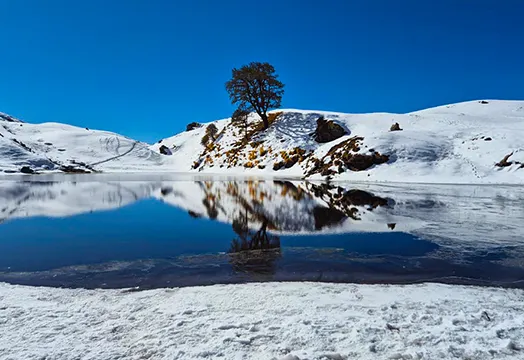

Winter is almost here, and you're still planning on following the same routine. Sitting in a blanket, sipping on hot tea, and binge-watching your favorite movies.
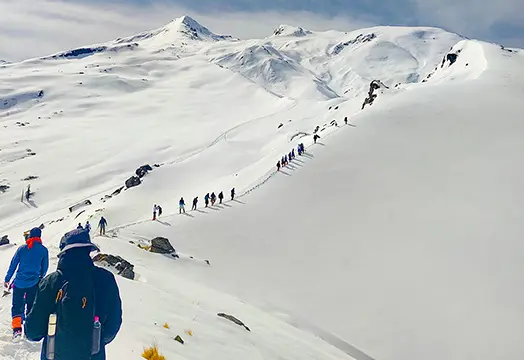
Every season in the Himalayas has its own way of showing off the mountains, but winter reveals a different side of them, one that feels like a whole new world.
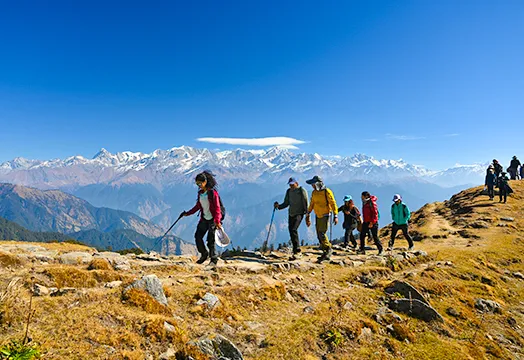
As monsoon season comes to an end, it washes away all the dust and haze that remains in the valleys throughout the summer, and then?
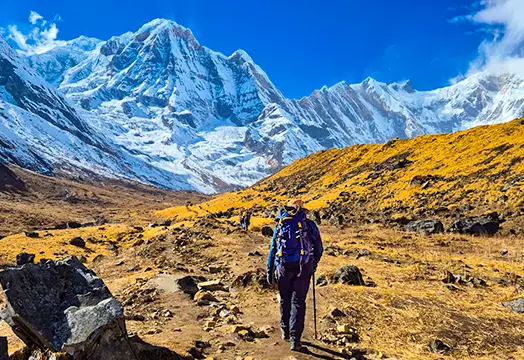
Located in north-central Nepal's Gandaki Province, Annapurna is the world's 10th highest and one of the most challenging mountains on the planet. Its height rises to 26,545 feet. Yet reaching Annapurna base camp is a far more accessible adventure, drawing trekkers from around the world every single season.
What does it feel like to stand on a trail where the mountain before you is worshipped as a goddess? For most of us, it's an adventure. But for the local communities who live in its shadow, it's something closer to faith. That mountain is Everest.

Over the last few decades, trekking has driven a profound shift: rural economies and local communities are reaping direct and indirect benefits.

Hiking teaches you to fall in love with the outdoors. Trekking teaches you to endure it. Mountaineering teaches you to respect it completely.

There are only a handful of Himalayan regions that hold profound spiritual significance as well as immense natural beauty. The Gaumukh Tapovan trek is one such destination that wonderfully combines adventure, divinity, and extraordinary Himalayan beauty.

What if a trek could leave you with more questions than answers? What if, after days of trekking, you reach a lake filled with centuries-old human skeletons?

Every year, every season reveals a new side of the Himalayan range. Be it trails covered in colourful rhododendrons or trails transformed into a lush green paradise, each season offers some of the most mesmerizing views of the Himalayas.
26 Oct 2026
25 Oct 2026
24 Oct 2026
23 Oct 2026
22 Oct 2026
21 Oct 2026
19 Oct 2026
18 Oct 2026
17 Oct 2026
16 Oct 2026