.webp)
.webp)
.webp)
.webp)
.webp)
.webp)
.webp)
.webp)
Satopanth Peak Expedition

Region
Uttarakhand | India

Duration
22 Days

Max Altitude
23210 Ft.

Trekking Km
79 KM

Grade
Challenging
Get in Touch with Our Trek Expert
91 8191004846 info@trekthehimalayas.comMonday - Saturday: 10 AM to 09.30 PM (GMT +5:30)
Sunday: 10 AM to 05.30 PM (GMT +5:30)
380000 /Person
- May-2026
- September-2026
- USD 5300 for Non-Indians and OCI card holders
- Services from Gangotri to Gangotri.
- Meeting Point( Pickup/ Drop Point ):Prince Chowk, Dehradun
(If transportation is opted from TTH) - Reporting Time: 6:00 am
- Drop Time: 6:30 pm to 7:30 pm (Timings are subject to change based on weather and road conditions).
- Please reach Dehradun a day before to avoid any delays.
Get in Touch with Our Trek Expert
91 8191004846info@trekthehimalayas.com
Monday - Saturday: 10 AM to 06 PM (GMT +5:30)
Overview
Trek Name: Satopanth Peak Expedition
Days: 22
Adventure Type: Mountaineering
Base Camp: Gangotri
Season:Summer | Autumn |
Month:May | June | September | October |
Country: India
Altitude: 23210 Ft.
Grade: Challenging
Rail Head: Dehradun
Stay: Guest House & Camping
Food: Meals while on trek & at Hotel/Guesthouse (Veg)
Location: Uttarakhand
Distance: 79 Km.
Trail Type: Summit, Point to point | Scale a peak, Camping at the same location upon returning.
AirPort: Jolly Grant Airport, which is 28 km away from Dehradun
Highlights:
- USD 5300 for Non-Indians and OCI card holders
- Services from Gangotri to Gangotri.
- Meeting Point( Pickup/ Drop Point ):Prince Chowk, Dehradun
(If transportation is opted from TTH) - Reporting Time: 6:00 am
- Drop Time: 6:30 pm to 7:30 pm (Timings are subject to change based on weather and road conditions).
- Please reach Dehradun a day before to avoid any delays.

Why is Satopanth a must-do climb?
- Climbing Satopanth offers the exhilarating experience of summiting a peak nearly 7,000 meters high in the Garhwal Himalayas.
- The climb offers breathtaking views of the surrounding Garhwal Himalayas, pristine beauty of the Satopanth Glacier, and its dramatic landscape, with snow-covered slopes and rugged terrains.
- Visit Gangotri Temple and the source of the Ganga River, Gaumukh.
- The spiritual aspect adds a deeper layer of meaning to the climb, making it a journey of both physical and spiritual significance.
- Satopanth offers the perfect challenge for climbers due to its steep slopes, glaciers, and ice climbing sections, requiring high-level mountaineering skills.
- Situated in a relatively less-explored region, the climb offers a sense of isolation and allows climbers to connect with nature in a remote and untouched environment, providing a sense of discovery and accomplishment.
- Its untouched landscape and challenging environment make it a unique destination for those looking for something challenging.

Who Can Participate
- Age Requirements:
- Minimum 18 years
- For Indian citizens: A basic mountaineering course is required.
- For non-Indian citizens: Must have successfully climbed at least one peak over 6,000m.
- Fitness Criteria:
- Trekkers must be able to carry a 10-15 kg backpack, as off-load options are not recommended.
- If a trekker's BMI is more or less than the normal range (18-25), please consult our Trek Coordinator before booking.
Satopanth Peak Expedition Itinerary
Arrival in Gangotri
- Altitude Gangotri: 3,100 m / 10,200 ft
- Drive Distance: 250 km (8–9 hrs)
Your journey begins in Dehradun, where you will embark on a scenic drive through the picturesque landscapes of Uttarakhand. The first stop on your route is Mussoorie, a renowned hill station known for its serene beauty and pleasant weather. It is often referred to as the "Queen of Hills," is a popular tourist destination offering stunning views of the Himalayas, colonial-era architecture, and a tranquil atmosphere. After Mussoorie, you continue your journey toward Uttarkashi, a town famous for its spiritual significance. Often called the "Kashi of the North," Uttarkashi is home to the revered Kashi Vishwanath Temple, dedicated to Lord Shiva, and attracts many pilgrims seeking blessings.
From Uttarkashi, your drive takes you through the enchanting Harshil Valley, a hidden gem nestled along the Bhagirathi River. The valley is known for its lush greenery, crystal-clear waters, and majestic views of snow-capped peaks, offering a refreshing contrast to the more bustling towns. Finally, after a scenic drive through Harshil, you will reach your destination: Gangotri.
Gangotri is one of the four sacred Char Dham pilgrimage sites and is considered the source of the Ganges River. Surrounded by rugged terrain and towering mountains, Gangotri offers a spiritual atmosphere, and the sight of the holy river flowing from the glaciers is truly awe-inspiring.
Rest & Acclimatization Day at Gangotri
- Altitude (Gangotri): 3,100 m / 10,200 ft
- Post lunch you can visit Gangotri Temple or go shopping.
Day 2 in Gangotri is planned as a rest and acclimatization day, allowing you to adjust to the higher altitude before continuing your journey. Start your day with a visit to Bhagirath Shila, a significant religious site where it is believed that King Bhagirath meditated in order to bring the holy Ganges River to Earth. This sacred rock is a peaceful place where many pilgrims come to offer their prayers, and it provides a serene environment for reflection. From Bhagirath Shila, take a short walk to Surya Kund. It is an ideal spot to relax and unwind, while also soaking in the calm, natural surroundings.
Next, head to the Gauri Kund Waterfall, located a short distance from the hot spring. This beautiful waterfall cascades down with great force, creating an impressive spectacle against the backdrop of the towering mountains. The serene ambiance around the waterfall provides the perfect opportunity to pause and connect with nature, with the sound of the rushing water adding to the tranquillity of the environment.
In the afternoon, embark on a light hike to Pandav Gufa, a small cave believed to have been used by the Pandavas during their journey to the Himalayas. According to local legend, the Pandavas, the heroes of the Mahabharata, rested here on their way to the mountains. The hike to the cave is not strenuous and offers an excellent opportunity to enjoy the stunning natural beauty of the region. Along the way, you’ll be treated to breathtaking views of the surrounding valleys and snow-capped peaks.
The rest of the day can be spent relaxing in Gangotri, taking in the peaceful atmosphere of this sacred place. By the end of Day 2, you should be well-acclimatized to the altitude, making you ready for the next phase of your spiritual and physical journey.
Gangotri to Bhojwasa
- Altitude:
- Gangotri: 3,100 m / 10,200 ft
- Bhojwasa: 3,800 m / 12,500 ft
- Trek Distance: 14 km | 7 hrs
- Accommodation: Guest House
On Day 3, after a hearty breakfast, the trek from Gangotri towards Bhojwasa begins. The journey starts with a pleasant walk before reaching the check post, where permits are verified. The trail then begins to gradually ascend, with the soothing sound of the Bhagirathi River flowing besides, providing a calm backdrop. As the walk continues, Mt. Sudarshan emerges in the distance, adding to the beauty of the landscape.
After covering a few kilometers, you will come across a boulder zone where the path becomes slightly challenging, but the effort is rewarded with a few small tea stalls where trekkers can take a brief rest and refuel with a warm drink. Continuing onward, you arrive at Chirbasa, a serene spot named after the chir trees that blanket the area, creating a peaceful atmosphere.
As the trail progresses, the valley gradually opens up, revealing majestic snow-capped peaks that dominate the horizon. Among these peaks, the stunning Bhagirathi Peak comes into view, standing tall and proud. The sight is truly awe-inspiring while trekking through this serene landscape.
Before reaching Bhojwasa, you pass through a few landslide-prone areas that require extra caution and careful navigation. These sections demand full attention during the journey. However, once Bhojwasa is reached, the effort is well worth it. Bhojwasa is an open campsite surrounded by magnificent views, where the towering Mt. Shivling can be seen in the distance. The Bhagirathi River flows gently beside the camp, creating a tranquil setting perfect for a night of rest and reflection after a day of trekking through such awe-inspiring terrain.
Bhojwasa to Nandanvan
- Altitude:
- Bhojwasa: 3,800 m / 12,500 ft
- Nandanvan: 4,500 m / 15,000 ft
- Trek Distance: 8 to 9 km | 5–6 hrs
- Accommodation: Tent
Today, to continue the journey beyond Bhojwasa, you have to cross the Bhagirathi River. Trekkers and locals alike rely on an age-old, manually operated trolley system to make the crossing. This traditional method is both fascinating and functional. A sturdy metal platform or basket is suspended on a cable, which stretches across the river, and it is the responsibility of a team of trekkers or local helpers to pull the trolley from one side to the other. The system operates through a simple yet effective rope-and-pulley mechanism, requiring strength and teamwork to navigate the fast-moving waters below.
The terrain beyond the crossing is rocky, and the path becomes more challenging as it winds through boulder sections that demand careful footing. Every step requires attention, as the trail often shifts between solid ground and loose rocks, making the journey feel both exhilarating and demanding. However, the beauty of the surroundings more than makes up for the difficulty.
As you continue along the Bhagirathi River, the sound of rushing water accompanies your steps, creating a soothing soundtrack to your journey. The river narrows, and with each twist and turn of the path, the landscape grows more dramatic. Eventually, after covering some distance, Gaumukh comes into view. The sight is nothing short of awe-inspiring. This is where the Bhagirathi River is born, from the mighty ice of the glacier.
From Gaumukh, the path leads into the heart of the Gangotri Glacier itself, a vast expanse of ice and mud that stretches as far as the eye can see. As you traverse this ancient glacier, you feel the raw power and serenity of nature in its most unspoiled form. The icy winds and the crunch of snow underfoot mark each step toward your next destination.
After a demanding trek across the glacier, the Nandanvan Campsite is reached. A peaceful spot nestled in the shadow of towering peaks. Here, the iconic Mt. Shivling stands proudly, its majestic, snow-capped peak a striking sight against the clear blue sky. The view of this sacred mountain is both humbling and breathtaking, a perfect reward after the long journey through challenging terrain. The campsite offers a much-needed rest, with the surrounding peaks and the tranquility of the glacier providing a sense of awe and reflection, marking the completion of another significant leg of the journey.
Nandanvan to Vasuki Tal (Base Camp)
- Altitude:
- Nandanvan: 4,500 m / 15,000 ft
- Vasuki Tal (Base Camp): 5,000 m / 16,400 ft
- Trek Distance: 7 km | 4–5 hrs
- Accommodation: Tent
Today’s journey is a relatively short one, but it’s no less significant. You begin with a steady, gradual ascent along the Chaturangi Glacier, the frozen expanse leading us toward Vasuki Tal. This will serve as our basecamp for the expedition, a place of both rest and preparation for the difficult days ahead. The path involves a diagonal traverse across the glacier, which requires focus and steady footing. After that, we face a brief but rewarding ascent, followed by an even shorter descent, bringing us to the peaceful shores of Vasuki Tal.
As we stand at the edge of the lake, surrounded by the towering peaks of the mountains, a deep sense of awe and respect settles in. The grandeur of the landscape amplifies the enormity of the task that lies ahead. Reaching the base of the mountain brings a humbling realization: the challenges, the risks, and the rewards of this expedition are all just beginning to unfold. It’s a quiet but powerful moment, a reminder of both the beauty and the difficulty of the journey we’re about to undertake in the coming days.
Day 6 & day 7 Rest & Acclimatization Day at Base Camp
- Check equipment and basic snow & ice craft training
- Rest day is highly advisable for better acclimatization
Day 8 to Day 19: Base Camp to Satopanth Peak summit and back to Base camp
- As weather in the mountains is highly unpredictable, we maintain a flexible schedule to adapt to changing conditions and ensure safety. These days account for load ferries between the camps, acclimatization, and buffer time for bad weather.
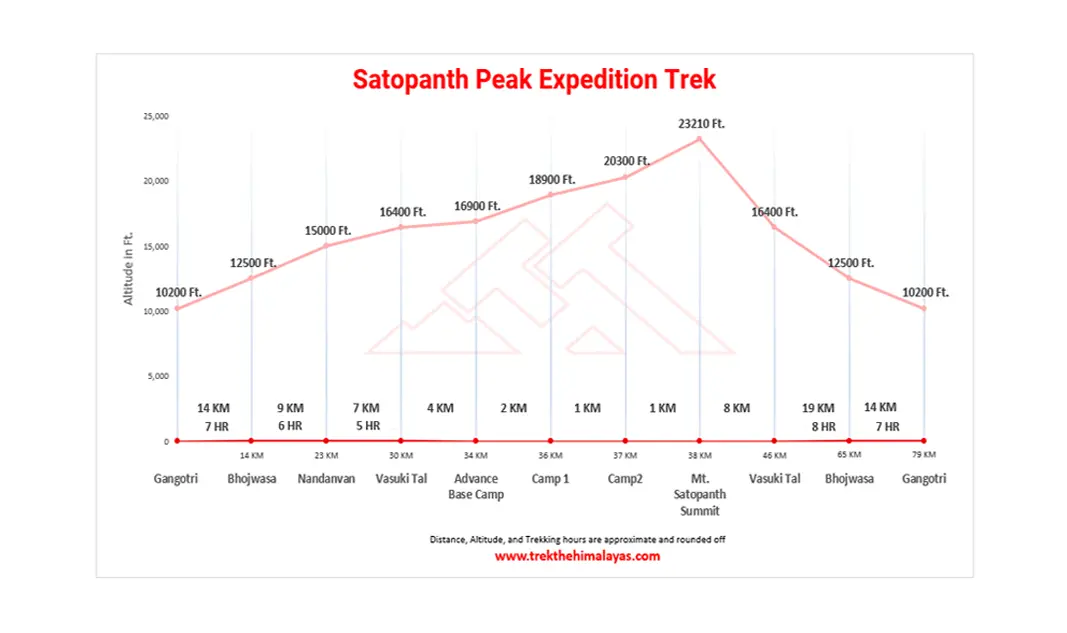
- Advance Base Camp: Altitude (5,140 m / 16,900 ft)
- Camp 1: Altitude (5,750 m / 18,900 ft)
- Camp 2: Altitude (6,200 m / 20,300 ft)
- Mt. Satopanth Summit: Altitude (7,075 m / 23,210 ft)
As the weather in the mountains can be highly unpredictable, the schedule remains flexible to adapt to changing conditions and ensure safety. These days account for load ferries between the camps, acclimatization, and buffer time for bad weather.
Advance Base Camp: The Advance Base Camp is located at an altitude of 5140 meters, offering a stunning view of the surrounding peaks. As you begin your trek, you’ll follow a narrow ridge, with the massive Chaturangi Glacier stretching out to your left and the majestic Vasuki Parvat towering to your right. The path gradually unfolds, and before long, you'll catch a glimpse of the iconic Mt. Satopanth in the distance, adding to the awe-inspiring scenery.
As you descend, you’ll approach Sundar Bamak, a vast glacier that marks a significant landmark on your journey. From here, you’ll take a right turn and continue walking for several kilometers. The terrain gradually leads you closer to your destination, and after covering this stretch, you’ll finally reach the Advance Base Camp, located at the lateral moraine of Sundar Bamak.
Camp 1: Camp 1 is set up at an elevation of 5,750 metres. The route to Camp 1 begins by heading eastward along the Sundar Bamak. After a short distance, you reach the base of the North-east ridge, which connects to the North face of Satopanth Peak. The ascent along the North-east ridge involves navigating through a mix of unstable rock and scattered ice patches. Camp 1 is established near a solitary Ice Pinnacle, marking the endpoint of this stage.
Camp 2: Reaching camp 2 is the most thrilling part of the climb, as the North-East ridge sharpens after Camp 1. This section, known as the Knife Ridge, stretches for about 1 km and demands technical skills to navigate. With near-vertical drops on both sides, the ridge offers stunning views. On the eastern side, you'll see the Suralaya Bamak Glacier, while to the west lies the Sundar Bamak. After skillfully crossing the ridge with the aid of fixed ropes, you'll reach Camp 2 at an elevation of around 6200 meters.
Mt. Satopanth Summit (7,075 m): The final push to the summit of Mt. Satopanth from Camp 2 is undoubtedly the most exhilarating and demanding part of the entire expedition. The ascent begins around midnight, when the surrounding environment is calm, and the temperatures are lower, making the ice and snow conditions more stable. This timing is critical for safety and for ensuring that the frozen surfaces are solid and secure.
The most technical and challenging part is crossing the boulder and rock patches, which require precise and careful maneuvering. This part of the route is negotiated with the help of fixed ropes, which are placed along the rock faces and boulders for climbers to rely on. This section requires not only physical strength and agility but also mental focus, as the rock and boulder surfaces can be tricky and require precision to navigate. It’s a strenuous and sometimes nerve-wracking part of the journey, demanding full attention and teamwork.
Reaching the summit of Satopanth at 7,075 meters is an incredible achievement, offering a truly rewarding experience. From the top, the expansive views are simply breathtaking. The jagged peaks of the Garhwal Himalayas stretch across the horizon, while the vast Tibetan Plateau unfolds in the distance. The landscape is stark, rugged, and awe-inspiring. This is an unforgettable moment that makes the challenging ascent well worth the effort.
Descend Back to Base Camp (Vasuki Tal): Descending from a mountain can often be more perilous than the ascent, as fatigue sets in and focus tends to wane. It’s crucial to maintain the same level of attention and caution as when climbing. Once the descent is completed safely, take the time to rest and rejuvenate at Base Camp. It’s the perfect opportunity to reflect on the journey, recover from the physical exertion, and prepare for the next phase of the adventure.
Vasuki Tal Base camp to Bhojwasa
- Altitude:
- Vasuki Tal (Base Camp): 5,000 m / 16,400 ft
- Bhojwasa: 3,800 m / 12,500 ft
- Distance: 19 km | 7–8 hrs
- Accommodation: Tent
After a peaceful and restful sleep, start your day by refreshing yourself. Take a moment to enjoy your morning meal, fueling up for the journey ahead. Once you're ready, pack your bags and prepare for the next leg of the trek. Today, you'll be heading back towards Bhojbasa, passing through the serene and picturesque Nandanvan.
As you set off, the trail will take you through the iconic Gaumukh, a significant spot along the way. Gaumukh, the mouth of the Ganges, holds both spiritual and natural importance, offering a serene atmosphere to reflect on your journey so far. You will be able to spot the majestic Bhagirathi and Shivling peaks, standing tall against the sky. Continuing your trek, you will make your way toward Bhojwasa, a place known for its stunning views and peaceful ambiance.
Along the way, you’ll experience a sense of deep connection with nature, and your heart will fill with gratitude for the stunning landscapes and the opportunity to be surrounded by such natural beauty. The descent might be physically demanding, but each step brings a rewarding sense of accomplishment.
Upon arriving at Bhojwasa, take time to rest and rejuvenate. The peaceful surroundings will offer a perfect setting to reflect on the journey and rest your tired muscles. The tranquil atmosphere of Bhojwasa will provide a sense of serenity, allowing you to fully appreciate the magnificence of the place and the journey you’ve undertaken.
Bhojwasa to Gangotri
- Altitude:
- Bhojwasa: 3,800 m / 12,500 ft
- Gangotri: 3,100 m / 10,200 ft
- Trek Distance: 14 km | 6–7 hrs
- Accommodation: Guest House
Today, the trek takes you from Bhojwasa back to Gangotri, signaling the end of a remarkable trek journey. The morning begins with a quiet sense of reflection, knowing that this is the last stretch of your path through the mountains.
Following the Bhagirathi River downstream, you walk the familiar trail through the whispering Chirbasa pine forests. The scenery gradually softens, shifting from the raw, high-altitude wilderness to the gentler charm of the lower valley. As you descend, you move through landscapes that have become part of your story. Sparkling waterfalls, cool streams, and the rugged cliffs that now feel like old companions. Stay mindful of the rocky sections, but also take time to enjoy the journey, letting your surroundings sink in one last time.
With every step, you bid farewell to the towering peaks that have silently accompanied you. Their presence fades from sight, but not from memory. A quiet pride begins to rise, the kind that comes from pushing boundaries, from walking in the heart of the Himalayas.
As Gangotri reappears on the horizon, that pride deepens. You’ve completed a trek rich in beauty and spirit. Back in the rhythm of town life, you might visit the temple for a final moment of gratitude or simply embrace the warmth, comfort, and rest awaiting you. A hearty meal and a peaceful night at a cozy guesthouse await.
After your meal, as you begin packing for the journey to Dehradun and, eventually, home, you carry with you more than just your belongings. You carry the stillness of mountain mornings, the clarity of glacial air, and the quiet strength found on a trail walked with purpose.
Gangotri to Dehradun
- Drive Distance: 250 km (9–10 hrs)
Your final day begins with the soothing comfort of morning tea in the sacred town of Gangotri. As the light spills over the mountains, take a quiet moment to bid farewell to the towering peaks that have stood watch over your unforgettable journey.
Before setting out, gather for one last group photo, a snapshot of the friendships forged and memories created amidst the serenity of the Himalayas. This simple gesture captures the spirit of camaraderie that has grown stronger with every step of the trek.
The return journey retraces your path through the awe-inspiring landscapes of Uttarakhand. The Bhagirathi River flows alongside, its gentle murmurs echoing the rhythm of your adventure. As you pass through the picturesque towns of Uttarkashi and Mussoorie, the road winds through ever-changing scenery from lush forests, cascading hills, to sweeping mountain vistas that remind you of the path you’ve conquered.
By late afternoon, you'll arrive in Dehradun. The circle completes, and with hearts full and spirits lifted, you part ways, carrying with you the stories, connections, and quiet strength found on the trail to Gaumukh Tapovan.
Day-1: Arrival in Gangotri
- Altitude Gangotri: 3,100 m / 10,200 ft
- Drive Distance: 250 km (8–9 hrs)
Day-2: Rest & Acclimatization Day at Gangotri
- Altitude Gangotri: 3,100 m / 10,200 ft
- Post lunch you can visit Gangotri Temple or go shopping.
Day-3: Gangotri to Bhojwasa
- Altitude:
- Gangotri: 3,100 m / 10,200 ft
- Bhojwasa: 3,800 m / 12,500 ft
- Trek Distance: 14 km | 7 hrs
Day-4: Bhojwasa to Nandanvan
- Altitude:
- Bhojwasa: 3,800 m / 12,500 ft
- Nandanvan: 4,500 m / 15,000 ft
- Trek Distance: 8 to 9 km | 5–6 hrs
Day-5: Nandanvan to Vasuki Tal (Base Camp)
- Altitude:
- Nandanvan: 4,500 m / 15,000 ft
- Vasuki Tal (Base Camp): 5,000 m / 16,400 ft
- Trek Distance: 7 km | 4–5 hrs
Day- 6 to 7: Day 6 & day 7 Rest & Acclimatization Day at Base Camp
- Check equipment and basic snow & ice craft training
- Rest day is highly advisable for better acclimatization
Day- 8 to 19: Day 8 to Day 19: Base Camp to Satopanth Peak summit and back to Base camp
- As weather in the mountains is highly unpredictable, we maintain a flexible schedule to adapt to changing conditions and ensure safety. These days account for load ferries between the camps, acclimatization, and buffer time for bad weather.
- Advance Base Camp: Altitude (5,140 m / 16,900 ft)
- Camp 1: Altitude (5,750 m / 18,900 ft)
- Camp 2: Altitude (6,200 m / 20,300 ft)
- Mt. Satopanth Summit: Altitude (7,075 m / 23,210 ft)
Day- 20: Vasuki Tal Base camp to Bhojwasa
- Altitude:
- Vasuki Tal (Base Camp): 5,000 m / 16,400 ft
- Bhojwasa: 3,800 m / 12,500 ft
- Distance: 19 km | 7–8 hrs
Day- 21: Bhojwasa to Gangotri
- Altitude:
- Bhojwasa: 3,800 m / 12,500 ft
- Gangotri: 3,100 m / 10,200 ft
- Trek Distance: 14 km | 6–7 hrs
Day- 22: Gangotri to Dehradun
- Drive Distance: 250 km (9–10 hrs)
Satopanth Peak Expedition Graph
- Pulse rate at rest must be in between (60 to 100 beats per minute).
- Blood Pressure Reading must be in between (DIASTOLIC 75 – 85, SYSTOLIC 100 - 130 mm Hg).
- Respiratory rate at rest must be in between (12 to 20 breaths per minute).
- Should not have Liver and kidney issues.
- Should not have Diabetes Mellitus, Bronchial Asthma, Heart problems, Hypertension, etc.
- No pacemaker implant.
- People with Sinus issues, Epilepsy please contact to trek coordinator before booking the trek.
- If your BMI is not normal, Please contact our Trek coordinator before Trek booking.
Medical & Disclaimer Form (Mandatory Documents) Click here to download Medical & Disclaimer Form
Government employees can avail the benefit of Special Casual Leave (SCL) when they join us for a trekking expedition. As per Pay Commission guidelines, up to 30 days of Special Casual Leave can be availed in a calendar year for trekking or mountaineering expeditions conducted through a registered organisation.
Trek The Himalayas is a registered adventure tour operator with the Indian Mountaineering Foundation (IMF) and the Ministry of Tourism (MoT), making your trek eligible for SCL benefits.
To apply, email us at info@trekthehimalayas at least 20 days before the trek departure date, with the following details:
- Trek name and trek date
- Booking details
- Full name
- Designation
- Department and department address
This benefit is exclusive to Indian Government employees and is applicable only for treks within India.
..
Since the inception of Trek The Himalayas, countless trekkers have chosen us to be a part of their trekking journey. Some experiences were learning moments, while many of you returned time and again, allowing us to be part of your most unforgettable adventures. Over the years, we have continuously evolved, improving our operations, and every detail that shapes your experience.
Through it all, you have shown us that we are not just another trekking company to you, we are family. Your trust, loyalty, and love mean more to us than words can express, and we cherish every step we have taken together in the mountains.
As a small way of giving back and saying thank you for choosing us again and again, we are excited to introduce something special: our heartfelt expression of gratitude to our valued and loyal trekkers.
We are launching two amazing policies to make your trekking journey even more exciting.
YES! Not one, but TWO unbelievable policies
Policy 1 : TTH Trek Ambassador Policy
In the TTH Trek Ambassador Policy, anyone who has completed four treks with us gets the fifth trek absolutely free. You can choose from a variety of treks that we offer in himalayan states of India including Ladakh, Uttarakhand, Himachal Pradesh, Sikkim and West Bengal. You just need to start creating your trek bucket list and we are here to help you accomplish it.
Thinking, “I have already done more than 6 treks with TTH, what about me?” In this case you automatically qualify for the policy and therefore, your next trek will be on us. In fact, for every 8 treks you complete, 2 treks are on us.
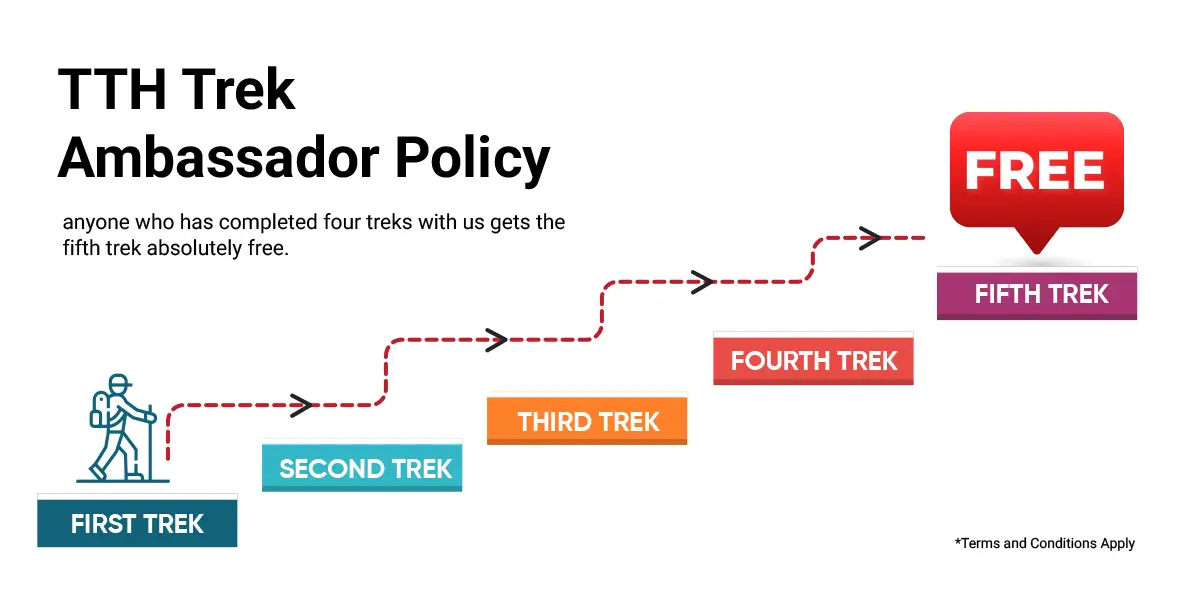
As Unbelievable as it Sounds, Your 5th Trek is Sponsored by Us - Choose any Trek You Love
Love the Chadar Trek? It could be free!
Your dream treks including Markha Valley, Bali Pass, Pin Bhaba Pass, or Lasermo La Trek (launching soon) can be yours at no cost under this policy.
Just like five stars make a perfect set, you are that fifth star for TTH. But this star does more than shine; it guides and inspires. You will share your tips, your stories, your experiences, and help new trekkers enjoy the journey as much as you do. That’s why this trek is special, and it’s your chance to be a TTH Trek Ambassador on the trail.
Being an avid trekker comes with excellent trekking knowledge and experience, and we would love you to share that and guide fellow trekkers along the way.
You will be introduced as our TTH Trek Ambassador to your fellow trekkers. Your experiences will glorify the shine of treks! And we can't wait, just to see how you make the journey just as beautiful as the Himalayan trails themselves!
What About Those Who are Just Getting Started?
Those who are just starting their trekking journey are also eligible for this policy, they just need to complete any four treks/expeditions with us (weekend treks, panch kedar excursion, and multi-sport adventures count too) and they will get the chance to become a TTH Trek Ambassador with their fifth trek absolutely free of cost.
Policy 2: Loyal Customer Policy
After you become a TTH Trek Ambassador with Trek The Himalayas, you will unlock our Loyal Customer Policy, a perk that keeps giving every time you share the joy of trekking.
Once you complete all four treks with TTH, you receive a unique referral code that you can share with your friends and family.
When someone books a trek using your code, you will receive trek points based on the difficulty level of the trek and the referred trekker will receive the same amount of discount while booking the trek. Here is the breakdown of the trek points and discount you and your friend will get.
- If the referred trek is an Easy trek, both of you will receive ₹500 as trek points and discount.
- For a Moderate or Moderate to Difficult trek, both will receive ₹700 as trek points and discount.
- For a Difficult trek, both will receive ₹1,000 as trek points and discount.
- For a Challenging trek, both will receive ₹1,500 as trek points and discount.
Kindly Note: 1 Trek Point = 1 Rupee
These trek points get added to your loyalty points balance and you can redeem these points while booking for your next trek. The more you refer, the more your balance grows.
For example:
If you collect 15,000 as your trek points, you can use them to book any trek within that value. As your balance grows, the possibilities expand and you could use your points for treks and expeditions of higher value anywhere in India, and abroad. Your loyalty points open the door to all kinds of trekking experiences in India and Internationally.
Another great part of this policy is its flexibility. You won’t believe it, but you can also transfer these loyalty points to anyone you like if you’re unable to use them yourself. You can either share or split them with friends or family.
You can also track your loyalty points balance anytime in your TTH dashboard, and we will also keep you updated through notifications whenever the trek points are added or redeemed.
TTH Trek Ambassador Policy FAQs
- What is this initiative all about?
- What if my upcoming trek is my fifth trek with Trek The Himalayas ?
- Can Chadar Trek be included as a free trek under this policy?
- Are weekend treks included in the count?
- I’ve already completed eight treks with TTH. Does this mean my ninth trek is also included?
- Why should I choose TTH over other organizations?
- If my child has completed four treks with TTH, can their Summer Camp be chosen as the fifth free trek?
- Which treks are eligible as free treks under the TTH Trek Ambassador Policy?
- Can I choose a Challenging grade as my free trek?
- How do I claim this benefit for my fifth trek?
- Do I need to make a payment while booking the fifth trek?
- If the trek is offered by TTH, why do I need to pay the amount upfront?
- Why does TTH follow a pay-and-return process?
- I already have multiple upcoming treks booked. Which one will be counted as my fifth trek?
- What if my four treks were registered using different email IDs?
- Can I choose international treks like Everest Base Camp or Kilimanjaro as my free fifth trek?
- Do repeat treks count toward my free fifth trek?
- Does the free trek cover things like insurance, transport, or extra charges?
- I’ve done some treks with other organizations. Do they count?
This initiative is our way of appreciating trekkers who continue to walk with TTH again and again. When you complete four treks with us, you reach an important milestone in your trekking journey. Your fifth trek is then offered by TTH as a gesture of appreciation. You will step in as a TTH Trek Ambassador, sharing your stories and inspiring others with your experience. Along with this, you also unlock Loyal Customer policy in which you can earn the trek points by sharing the referral code with your friends and family.
If your upcoming trek is your fifth trek with TTH, the trek fee for that trek will be completely waived. To ensure smooth planning, you need to register and make the full payment at the time of booking. Once you successfully complete the trek, TTH will refund the eligible trek fee within a week.
Please note that GST and trek insurance are fixed mandatory charges, so they will not be refunded. Any optional add-ons, like transport, gear rental, offloading, or special meals, are also outside the refund scope.
Yes, it absolutely can. And that’s what makes this policy special. If trekking in Ladakh has been your dream, this could be your moment. Iconic treks like Chadar Trek and Markha Valley Trek are available as options for your free fifth trek.
Of course! A trek is a trek, and all your TTH treks, including weekend or two-day treks count toward your free fifth trek.
Yes, and this is one of the nicest parts of the policy. The free trek benefit works in groups of four treks. After completing four treks, your fifth trek is free. If you have completed eight treks, the benefit comes again, and your ninth and tenth treks will also be free. In short,for every four treks completed with TTH, you earn free treks along the way. The more you trek, the more TTH gives back.
Trek The Himalayas offers a wide range of treks be it easy to moderate treks like Kedarkantha, Har Ki Doon, Ranthan Kharak or moderate to difficult treks like Bali Pass, Pin Bhabha Pass or Chadar. By the time you complete four treks in the Himalayas, you have already grown into an experienced trekker.
Naturally, you would now like to prefer to take a step up and choose a difficult trek as your fifth one. Here is where Trek The Himalayas stands out as it offers a variety of difficult treks. And luckily all of them are qualified as free treks under the TTH Trek Ambassador policy. With TTH, you get a variety of trek options to choose from. You can pick a tougher trail or go for an Easy or Moderate trek; the choice is yours.
Yes definitely, we’re happy to offer this. Young trekkers bring fresh energy and enthusiasm to the trail, which makes the journey even more special. If your child has completed four treks with TTH, they can choose a Summer Camp as their fifth free trek.
You’ll be happy to know that any himalayan trek from easy to difficult level can be chosen as your free trek. The best part is that treks like Chadar Trek, Markha Valley, and many other beautiful himalayan treks are included. You may also choose higher-grade treks such as Bali Pass or Pin Bhaba Pass as part of your free trek.
As a TTH Trek Ambassador, your role goes beyond just trekking. You become a mentor on the trail. Someone who guides and shares real experiences with fellow trekkers. After completing multiple treks with TTH, you bring valuable knowledge and perspective that naturally encourages others and adds energy to the group.
Your stories and practical tips help first-timers and intermediate trekkers feel more comfortable and motivated. This is where your experience shines and lifts the overall trekking spirit of the group.
Challenging and peak summit treks, however, follow a slightly different approach. These treks are designed for highly experienced trekkers and climbers, where every participant is already well-prepared and self-driven. In such settings, there is limited scope for peer mentorship, as the structure and demands of the trek are very specific.
That’s why challenging and peak summit treks are kept outside the free fifth trek option, not because they are out of reach, but because the Trek Ambassador role is best experienced on trails where your guidance, encouragement, and shared journey can add value to others.
To claim your free trek, please send an email to info@trekthehimalayas.com, and our team will take it forward from there.
Yes, you do. You need to pay the full amount at the time of booking, just like any regular trek. Once you successfully complete the trek, we process the return of the eligible trek fee within one week. This process helps us plan treks better and ensures that all participants are fully committed.
Each spot on a trek involves planning, logistics, and local arrangements. If someone cancels at the last moment, it directly affects the team and the opportunity for another trekker. Collecting the payment upfront helps us manage this responsibly. Once you complete the trek, the amount is returned as promised. If you cancel, the standard TTH cancellation policy applies.
To keep your trek planning smooth and fair, we collect the trek fee upfront. Last-minute cancellations can affect team arrangements and local logistics, so this pay-and-refund process keeps everything running smoothly while still giving you this special benefit fairly.
The trek that you actually complete as your fifth eligible trek will be considered under this initiative. Even if you have several treks booked in advance, the benefit applies to the trek that completes your fifth-trek milestone.
All four treks must be registered under a single email ID. This helps us confirm that the same person has completed all four treks with TTH. Please ensure your records are linked to one email ID.
The free fifth trek is only valid for treks within India. International treks, including those in Nepal or other countries, don’t qualify as your free trek. However, any international trek you’ve completed does count toward your total number of treks with TTH.
Each unique trek you complete adds to your total. If you repeat a trek you’ve already done, it won’t be counted toward your free fifth trek.
The free trek includes only the trek fee itself. Any extra costs like trek insurance, transport, gear rentals, offloading, or special meals are not included and will need to be paid separately.
To be eligible for the free fifth trek, we count only treks you’ve completed with TTH. But don’t worry, even if you’ve done weekend treks, pilgrimages, or international treks with us, they all contribute to your count. By the time you’re eligible, you’ve likely completed more than four treks with TTH anyway.
Loyal Customer Policy FAQs
- What is the Loyal Customer Policy?
- When do I become eligible for this policy?
- What is a referral code and how do I get it?
- Is there a limit to how many points I can earn?
- What is the minimum number of trek points I can redeem under this policy?
- Can I use these trek points for international treks?
- Can I transfer my trek points to someone else?
- Where can I check my trek points balance?
- Can I share my referral code with someone who has already trekked with TTH?
- What is the validity of the Loyalty points?
The Loyal Customer Policy is a special perk for TTH Trek Ambassadors. After completing four treks with Trek The Himalayas, you receive a referral code. When someone books a trek using your code, both you and the referred trekker earn trek points and discounts based on the difficulty level of the trek.
You become eligible for the Loyal Customer Policy after completing four treks with Trek The Himalayas and becoming a TTH Trek Ambassador. Make sure all your four treks must be unique.
A referral code is a unique code provided to you once you become a TTH Trek Ambassador. You can share this code with friends and family. When they use it while booking a trek, both of you receive trek points and discounts.
There is no limit to the number of trek points you can earn. The more you refer, the more points get added to your loyalty points balance, which you can redeem while booking your future treks.
There is no minimum limit for redeeming your trek points under this policy. You can start redeeming your rewards with as little as one trek point. Every trek point you earn holds value, giving you complete flexibility to use your points whenever and however you choose without waiting to accumulate a fixed number.
Yes! One of the best parts of the Loyal Customer Policy is that you can use your trek points to book any trek with TTH, including international treks.
This is the flexibility of the policy. You can easily transfer your points to friends and family, and they can use them for their own trek planning with TTH. Even if you want to split the points and use them with your friends, you can do that too and enjoy trekking together!
You can easily track your trek points anytime in your TTH dashboard. Also, we’ll keep you updated with notifications whenever points are added or redeemed, so you always know your balance.
No. Referrals must be for completely new members. Anyone who has already registered or trekked with TTH earlier will not be counted as a valid referral.
The Loyalty Customer accumulated points is valid for two years from the date it is issued.
Important Links
- Mandatory Documents to Bring on A Trek Click Here.
- How to pay Add-ons, Submit Medical Forms, and Dietary Preferences Click Here to watch Video
How To Reach
Pick-Up Information
- It is essential for everyone to arrive at Prince Chowk, Dehradun (06:00 am).
- Once you have reached Dehradun, TTH will manage the rest of your travel arrangements, if you have opted for TTH's pick-up service, you can select this option during the booking process by adding it as an add-on.
Options to Reach Dehradun
First, you can arrive at Delhi, Dehradun Airport or Chandigarh. The journey from these locations to Dehradun is explained below.
1. Take an overnight train from Delhi to Dehradun.
2. Take a bus to Dehradun ISBT from Delhi Kashmiri gate ISBT or Chandigarh Sector 17 Bus stand, and then take local transport to the pickup point (Prince Chowk).
Delhi to Dehradun - 250km | 6hr.
Chandigarh to Dehradun - 220km | 5hr
The distance from the Dehradun Bus Stand (ISBT) to the Railway Station is 6 km, without traffic, it will take 15 minutes.
( We always recommend to go for the govt. Buses over the private ones outside the bus station as based on the experience we have found that there are very high chances of delay involved with private buses. Also, govt. Buses are always more reliable. Whichever bus you choose, just make sure to reach Dehradun at least by 05:30 am positively. )
3. Take a flight to Dehradun airport (Jolly Grant Airport), then from the Airport to Prince Chowk, Dehradun Distance is 30km and it will take around 1 hr( if coming by flight then reach one day early).
Drop-Off Information
- The designated drop-off point is Prince Chowk, Dehradun.
- Arrive in Prince Chowk by 6:30 to 7:30 pm.
- Please consider planning your subsequent travel arrangements after 9:00 pm.
- The distance from the Railway Station to Dehradun Bus Stand (ISBT) is 6 km, it will take approx 25 minutes.
- The distance from Railway Station to Dehradun Airport is 30km, it will take approx 1hr.
- It's highly advisable to keep a buffer day in your travel plan. If the buffer day is not needed, it can be used to explore Dehradun/Mussoorie/Rishikesh.
( If you prefer to travel independently to Base camp and don't want to take TTH's pick-up service, you can either take a government bus or book a private cab from Dehradun. Your trek coordinator will provide guidance on how to arrange for the bus or cab booking. )
TTH offers comfortable transportation through Tempo Traveler, Bolero, or equivalent vehicles. If you wish to upgrade your mode of transportation, please contact your trek coordinator for further assistance.
.webp)
.webp)
Cost Terms
Inclusion
1. Accommodation (as per the itinerary):
- Guest houses on Day 1 & 21 at Gangotri (triple/quad sharing).
- Camping during the expedition (Day 2 to Day 20).
2. Meals (Veg):
- All meals are from Gangotri to Gangotri.
- Day 1 to Day 21 Dinner.
3. Support:
- 1 Versatile base camp manager: handles communication and deploys extra manpower in emergencies.
- 1 Mountaineering & First aid qualified professional expedition Leader.
- 1 Experienced high altitude chef.
- Local experienced guides (Number of guides depending on the group size).
- Enough support staff.
4. Trek equipment:
- Sleeping bag, Sleeping liners (if required), Mattress, Utensils.
- 3 men all season trekker tent (twin sharing), Kitchen & Dining tent, Toilet tent.
- Camping stool, Walkie talkie.
- Ropes, Helmet, Ice axe, Harness, Gaiters & Crampon (if required).
5. First aid:
- Medical kit, Stretcher, Oxygen cylinder, Blood pressure monitor, Oximeter, Stethoscope.
6. Transportation (as per the itinerary):
- Dehradun to Gangotri& return.
7. Cloakroom service at base camp.
8. Porters to carry the central luggage.
9. All necessary permits and entry fees, up to the amount charged for Indian.
10. Services from Dehradun to Dehradun.
11. Expedition completion certificate from TTH.
Exclusion
1. Insurance (Mandatory).
2. Food during the transit.
3.
Any kind of personal expenses.
4. Mule or porter to carry personal luggage.
5.
Emergency evacuation, hospitalization charge or etc.
6. Anything not specifically
mentioned under the head Inclusion.
Things can be provided on demand and availability (participant has to pay extra for these things).
1- Satellite phone/set phone - is a type of mobile phone that connects via radio links via satellites orbiting the Earth instead of terrestrial cell sites like cellphones. Therefore, they can operate in most geographic locations on the Earth's surface.
2- Gamow/PAC HAPO Bag (Portable Hyperbaric Bag) - is a unique, portable hyperbaric chamber for the treatment of acute mountain sickness (AMS), also known as altitude sickness.
3- AEDs (Automated External Defibrillators) - are portable life-saving devices designed to treat people experiencing sudden cardiac arrest, a medical condition in which the heart stops beating suddenly and unexpectedly.
Cancellation Terms
To request a cancellation, please email us at info@trekthehimalayas.com using your registered email ID.
Cancellations prior to 25 days from the start of the Trip
Refund Options
- 5% deduction of trek fee
- 100% trek fee cash voucher for any trip till one year
- Transfer your trek (any trek, any date) to your friend
Cancellation between 24 days and 15 days to the start of the Trip
Refund Options
- 30% deduction of trek fee
- 100% trek fee cash voucher for same trip till one year
- 85% trek fee cash voucher for any trip till one year
- Transfer your trek (same trek, any date) to your friend
Cancellation between 14 days and 10 days to the start of the Trip
Refund Options
- 50% deduction of trek fee
- 80% trek fee cash voucher for same trip till one year
- 70% trek fee cash voucher for any trip till one year
- Book the same trek, in the same season, with any other batch
- Transfer your trek (same trek, any date) to your friend
Cancellation less than 9 days to the start of the trek.
Refund Options
- No cash refund
- 20% trek fee cash voucher for the same trip till one year
- 10% trek fee cash voucher for any trip till one year
- Transfer your trek (same trek, same date) to your friend
- To reschedule a trek (same trek only), a 30 % rescheduling fee of the trek cost will apply.
Cancellation Policy (Emergency Cases):
In case of a death in the immediate family (parents, siblings, spouse, children) or if the trekker is hospitalized (min. 48 hours) or suffers a fracture (leg/arm) within a week before the trek, even if canceled a day before:
90% trek fee refund in cash & 10% as a voucher (valid for 1 year, for any India trek).
Valid documents required. We’re here to support you during tough times.
Note:
- Change of trek batch is dependent on the availability of seats in the batch
- In case of transferring a trek to a friend, he/she should satisfy all the mandatory requirements put forward by TTH
- TTH holds the right to change/cancel the policies, without prior notice
Booking and Payments
- The Participant is responsible for verifying the accuracy of all details, including Trip dates and personal documentation, at the time of booking.
- Payments must be made in accordance with the timelines and instructions provided by TTH. Late payments may result in cancellation of booking without refund.
- In the event of a cash refund, only the portion of the payment made in cash shall be eligible for refund in cash. Any booking made using voucher, discounts, promotional codes, or through any non-cash mode of payment shall not be eligible for a cash refund under any circumstances.
- Refunds, if applicable, shall be processed within 15–30 working days of confirmation.
- All add-on bookings are subject to the respective add-on cancellation policy, and refunds will be processed accordingly.
- Voucher Terms
- This is a non-transferable voucher
- The voucher cannot be merged with any other offer of Trek The Himalayas
- The voucher is valid for Trek booked directly with Trek The Himalayas in India
- To avail the voucher please use your register phone number or e-mail id
- All the other Terms of booking a trek with Trek The Himalayas are applicable to the voucher
Itinerary and Modifications
- TTH reserves the right to modify, shorten, or cancel any part of the Trip due to transportation delays, weather, health emergencies, or other unforeseen circumstances including Force Majeure.
Cancellations and Refunds
- No refunds or vouchers, partial or otherwise, shall be provided for voluntary withdrawal, non-utilisation of services, or removal from the Trip.
- If TTH cancels the Trip before arrival at the designated pick-up point due to unforeseen circumstances or Force Majeure, the Participant may choose from:
- An alternate Trip/date.
- A credit voucher valid for one (1) year.
- Transfer to another Trip, with cost differences payable by the Participant.
- If the Trip is abandoned post-arrival at the designated pick-up point, no cash refund or voucher shall be issued. The Trek Again Policy may apply at TTH’s discretion.
- TTH shall not be liable for any associated travel costs such as flights, accommodation, or visa fees.
Force Majeure
- Events beyond its control including but not limited to earthquakes, landslides, strikes, curfews, war, pandemic, government restrictions, heavy rainfall or snowfall, windstorms, road blockages, trail disruption, or withdrawal of permits, TTH shall not be held liable for any cancellation, delay, or service modification caused by Force Majeure.
Trek Essentials
Rent EquipmentPDF Of Trek Essential Download
| Backpack with rain cover | (60 - 70 ltr) with comfortable shoulder straps |
| Day pack with rain cover | 20 - 30 ltr |
| Walking stick | Advisable (At least one) |
| Water Bottle / Hydration pack | 2 bottles of one liter each, People who use hydration pack 1 hydration pack and 1 bottle of one liter, Carry at least one thermos flask. |
| Small size tiffin/lunch box | 1 Nos |
| Snacks | Energy bars, dry fruits, electral/ors |
| Personal Medical Kit | Consult your doctor |
| T-Shirt (Synthetic quick dry) | 2 Full & 2 Half sleeves |
| Fleece T-shirt | 2 Nos. |
| Fleece jacket | 1 Nos |
| Windproof Jacket | 1 Nos. |
| Down feather / Hollow jacket | 1 Nos. |
| Thermal inner (Upper and Lower) | 1 Pair |
| Trek Pant (Synthetic quick dry) | 3 Nos. |
| Fleece Pant | 1 Nos. |
| Waterproof gloves | 1 Pair |
| Fleece / woollen gloves | 1 Pair |
| Poncho / waterproof Jacket and pant | 1 Nos. |
| Sunscreen | 1 Nos. |
| Moisturiser | 1 Nos. |
| Chap-stick / Lip balm | 1 Nos. |
| Toothbrush and toothpaste | 1 Nos. |
| Toilet paper & Wipes | 1 Nos. |
| Soap / hand sanitizers | 1 Nos. |
| Antibacterial powder | 1 Nos. |
| Quick dry towel | 1 Nos. |
| Head torch | 1 Nos. (Avoid Hand torch) |
| Sun Cap | 1 Nos. |
| Woolen cap | 1 Nos. |
| Balaclava | 1 Nos. |
| Buff / Neck-gaiters | 1 Synthetic & 1 Woollen |
| Sunglasses | UV with dark side cover, People who wear spectacles - (A)- Use contact lenses | (B)- Photo chromatic glasses |
| Trekking shoes | 1 Pair (Water-resistant, high ankle, good grip) |
| Floaters / flip-flops | 1 Pair |
| Cotton socks | 10 pairs |
| Woollen socks | 3 pairs |
| Gaiters | 1 Pair (TTH provides when required) |
| Micro spikes | 1 Pair (TTH provides when required) |
Frequently Asked Questions(FAQ)
To register with TTH, visit our website - www.trekthehimalayas.com and create your account. To create your account you will need to use your email address and fill in all the details, set your unique password and your account is ready to use.
- To book a trek with TTH, you first need to register with us and create an account.
- Choose the trek that you want to do and click on available dates.
- You will land at the login page, fill in the required details.
- Add Participants, choose add-on services click on the Pay now button, choose your preferred payment method, and make the payment. TTH accepts multiple payment options, including credit/debit cards, net banking, and UPI.
- You will receive a confirmation email from TTH with all the necessary details about the trek, including the meeting point, transportation, accommodation, and other important instructions.
- Click Here to watch Video
please send an email to us at info@trekthehimalayas.com or reach out to the numbers provided in the Help and Support section of your Trek Page. We will ensure that your issue is promptly resolved.
To book services such as off-load luggage and transportation, you can find them listed as add-ons. These additional services can be booked at the time of your initial booking. If you miss booking add-ons during the initial reservation, you can log in anytime and easily book 4 days before the departure date add-ons through the platform.
If you have booked the wrong trek or selected the wrong date, don’t worry! You can contact us at +91 9368882322 (Monday to Saturday, 10 AM to 10 PM) or email us at info@trekthehimalayas.com. You can also discuss this with your trek coordinator. Please make sure to inform us at least 10 days before the departure of your trek. Only then can we help you reschedule or arrange another trek for you.
We recommend visiting our "Suggest Me a Trek" page. By filling out the form, our experts will contact you with the best possible trek options based on your preferences and experience level. Alternatively, you can reach out to us via email at info@trekthehimalayas.com or give us a call using the numbers provided on our website for personalized assistance and recommendations.
Family treks differ from regular treks by focusing on ease of difficulty, offering shorter durations for younger participants, Kid-friendly and easily digestible foods, child-friendly activities, maintaining a higher guide ratio for diverse age groups, and implementing additional safety measures for families.
Family Trek with Kids recommendation Only Dayara Bugyal and Chopta Chandrashila Trek.
Minimum age for TTH treks is typically 7 years, though this may vary depending on the specific trek.
Yes, you can take a kids to a high-altitude trek with a parent. Discuss with a trek expert before booking a trek.
- Junior trekkers (below 15 years) should have a company of parents/guardians.
- Trekkers between 15 to 18 years can come solo with the disclaimer form signed by parent/guardian.
- Medical & Disclaimer Form (Mandatory Documents) Click here to download medical and disclaimer form
Physical Fitness: Ensure your child is physically fit. Engage them in regular exercise, outdoor activities, and hikes to build stamina and endurance. Hydration: Emphasize the importance of staying hydrated at high altitudes. Encourage your child to drink water regularly, even if they don't feel thirsty. Proper Nutrition: Provide a well-balanced diet with sufficient carbohydrates for energy and foods rich in iron to prevent altitude sickness. Adequate Sleep: Ensure your child gets enough sleep in the days leading up to the trek. Quality rest is crucial for altitude adaptation. Educate on Altitude Sickness: Teach your child about the symptoms of altitude sickness, such as headache, nausea, and dizziness. Encourage them to communicate any discomfort immediately. Appropriate Clothing and Gear: Dress your child in layers to adjust to changing temperatures. Ensure they have appropriate trekking gear, including sturdy footwear. Positive Mindset: Foster a positive mindset. Encourage your child, and let them know it's okay to take breaks when needed. Medical Check-Up: Schedule a medical check-up before the trek to ensure your child is fit for high-altitude activities. Consult with a healthcare professional about any potential health concerns.
TTH takes special care to provide wholesome and nutritious food for children on treks. Here are some of the foods that are typically served for children:
Breakfast: For breakfast, TTH serves a variety of options like porridge, cornflakes, bread, butter, jam, honey, boiled eggs, omelettes, and pancakes. Children can choose from these options to fuel themselves for the day's trek.
Lunch: For lunch, TTH serves lunch which includes rotis, vegetables, rice, dal, and salad. The rotis are usually made fresh on the trek and are a good source of carbohydrates. The dal and vegetables provide protein and other essential nutrients.
Snacks: TTH provides healthy snacks like fresh fruits, dry fruits, energy bars, cookies, and biscuits to keep the children energized throughout the day.
Dinner: For dinner, TTH serves a hot and wholesome meal which includes soup, rice, dal, vegetables, and a non-vegetarian dish (if requested in advance). Children can also choose from a variety of desserts like custard, jelly, and fruit salad.
Dietary requirements: If a child has any special dietary requirements, TTH can cater to those needs as well. For example, if a child is lactose intolerant or allergic to nuts, the kitchen staff can make arrangements to accommodate those requirements.
Choosing the right trek for a beginner can be a bit overwhelming as there are many factors to consider such as distance, elevation gain, terrain difficulty, weather, and time of year. Here are some tips that can help you choose the right trek for a beginner:
1. Determine fitness level: Assess the fitness level of the beginner to understand their physical capabilities. This will help you select a trek that is challenging but not too difficult.
2. Choose a well-traveled trail: A well-traveled trail will have more amenities such as signposts, water stations, and shelter. It is also safer as there will be other hikers on the trail.
3. Consider the length of the trek: For beginners, it is recommended to start with a shorter trek that can be completed in a day or two. This will help them get acclimatized to trekking and build their confidence.
4. Look for gradual elevation gain: Choose a trek with a gradual elevation gain rather than steep ascents. This will make the trek easier and more enjoyable.
5. Check the weather: Check the weather forecast before selecting a trek. Avoid treks during the monsoon season or winter when the trails can be slippery or dangerous.
6. Research the trail: Read about the trail to get an idea of the terrain, altitude, and difficulty level. This will help you select a trek that is suitable for the beginner.
7. Consult with an expert: If you are unsure about which trek to choose, consult our trek expert Mr. Nitin (+91 70600 59773) between 10 AM to 6 PM (Tuesday - Friday). Mr. Nitin will provide you valuable advice and guidance.
Overall, it is important to choose a trek that is enjoyable, challenging but not too difficult, and suitable for the beginner's fitness level and experience.
It is not recommended for a beginner to choose a difficult Himalayan trek. Trekking in the Himalayas can be physically and mentally challenging, especially if you are not used to the high altitude, steep slopes, and rugged terrain. Choosing a difficult trek without the proper experience, fitness level, and preparation can be dangerous and put you at risk of altitude sickness, injury, and other hazards.
If you are a beginner, it is recommended to start with an easier trek and gradually build up your skills and experience. This will help you understand the challenges of trekking in the Himalayas, and also prepare you physically and mentally for a more difficult trek in the future. It is also important to choose a trek that matches your fitness level, experience, and interest.
There is no specific age limit for a beginner trekker. However, it is important to consider your physical fitness, health condition, and personal interests before embarking on a trek. Trekking in the Himalayas can be physically and mentally demanding, and requires a certain level of physical fitness and endurance.
If you have any pre-existing medical conditions or are above a certain age, it is recommended to consult with a doctor before embarking on a trek. It is also important to listen to your body and take breaks as needed during the trek to prevent exhaustion or injury.
We recommend visiting our "Suggest Me a Trek" page. By filling out the form, our experts will contact you with the best possible trek options based on your preferences and experience level. Alternatively, you can reach out to us via email at info@trekthehimalayas.com or give us a call using the numbers provided on our website for personalized assistance and recommendations.
Yes, you can join the trek. We have fixed departure groups where you can simply book your trek and we will take care of curating a group.
Before you start the trek, it is recommended that you make all the necessary phone calls as during the trek you may or may not receive network coverage, once you come back to the Base Camp, you can reconnect with your family via phone once again. You can share your trek coordinator contact detail with your family members to get the latest updates about your trek batch.
At TTH, we provide wholesome and nutritious meals during the trek. The food is vegetarian and includes a variety of dishes such as rice, dal, vegetables, chapati, paratha, pasta, noodles, and soup. We also offer snacks such as biscuits, and salty, and dry fruits during the trek. Special dietary requirements such as vegan, gluten-free, or Jain food can also be arranged if informed in advance.
If you are allergic to some foods, you need to let us know in advance so that we can make arrangements accordingly.
TTH is a trekking company that prioritizes the safety of all its participants, including women trekkers. We have a comprehensive safety system in place, which includes a dedicated team of experienced and trained trek leaders and support staff who are equipped to handle emergency situations and provide first aid.
TTH also takes specific measures to ensure the safety and comfort of women trekkers. They have a separate tent accommodation for women trekkers, female trek leaders, and support staff. They also provide separate toilet facilities for women and encourage a safe and respectful environment for all trekkers.
Moreover, TTH has a strict policy against any kind of harassment and has a zero-tolerance policy towards such incidents. They have a designated Internal Complaints Committee (ICC) to investigate and address any complaints related to harassment or misconduct. Overall, TTH has a good reputation for safety and responsible trekking practices, and women can feel comfortable and safe while trekking with them.
In case you are the only women in the group, we provide a single sleeping arrangement. Also, during the trek, the trek leader will always remain by your side to provide optimum safety and reassurance.
You can reach out to the trek coordinator to inquire about the number of female trekkers and their respective states who have booked the trek. Please note that the trek coordinator cannot disclose personal details of any trekker. Once you've confirmed your booking, a WhatsApp Group will be created for all the trekkers in your batch. This allows you to connect with fellow trekkers before the trek begins.
While many of our treks are led by female trek leaders, however, it is not possible to know which trek leader is assigned to which group. But nonetheless, whether the trek leader is male or female you can be completely assured of your safety and security with us.
Yes, it is possible to trek with periods. However, it is important to take some extra precautions and preparations to ensure a comfortable and safe trekking experience. Here are some tips that can help you trek during your period:
1. Use menstrual hygiene products that you are comfortable with, such as tampons, pads, or menstrual cups. It is recommended to carry enough supplies for the entire duration of the trek.
2. Pack wet wipes, hand sanitizer, and plastic bags to dispose of used hygiene products.
3. Wear comfortable and breathable clothing that allows for easy movement and reduces friction. Avoid wearing tight or restrictive clothing that can cause discomfort.
4. Carry pain relief medication, such as ibuprofen or acetaminophen, in case of menstrual cramps.
5. Stay hydrated and maintain a balanced diet to support your energy levels and overall health.
6. Take breaks as needed and listen to your body. If you feel uncomfortable or experience any unusual symptoms, seek medical attention immediately. It is also recommended to consult with a doctor before going on a trek during your period, especially if you have a pre-existing medical condition or are taking medication.
By taking necessary precautions and being prepared, you can have a safe and comfortable trekking experience even during your period. We provide proper disposal facilities for sanitary pad disposal during the trek.
We offer three person tents with twin-sharing for optimum comfort. A woman trekker will share a tent with another woman trekker and if you are the only woman in the group, you will be given a single accommodation for your comfort and privacy.
Yes, we do provide gears on rent. You can book it using you TTH account directly.
Mountaineering qualified Experienced and first aid certified Trek Leader, First Aid Certify local guide, Cook, helpers and supporting staff.
People suffering from Bronchitis, Asthma, High blood pressure, Epilepsy (got faints), TB , Heart problem or on higher BMI side are strictly not allowed to go on any Himalayan trek. Apart from this if you had any medical history, please let us know.
No. Alcohol and smoking isn’t allowed while on trek. It is totally misconception that it will keep you warm. Your body need to acclimatize properly and for that eat properly and drink enough water; these things will keep you warm.
Toilet tents provide a convenient solution for answering nature's call in the great outdoors. Dry toilets, in particular, offer a highly sanitary approach. By digging a pit and utilizing mud and a shovel, you can easily cover up your waste. This method ensures cleanliness and hygiene while camping or exploring in the forest.
Remember to pack essential toiletries to complete your outdoor bathroom kit and maintain proper personal hygiene during your adventures. With these practices in place, you can enjoy nature while also respecting it.
Layer Up From Head To Toe
Eat Full Meals, never sleep empty stomach
You can keep warmee (if you’re more susceptible to cold).
Use sleeping bag in right way and don’t leave free space in sleeping bag.
For upper body
– Thermal layer
– T-shirt (full-sleeves)
– Fleece T-shirt (for extreme colds)
– Fleece layer
– Thick Jacket/Down Jacket
– Waterproof or Windproof layer (outermost layer, when it is snowing or raining)
- For Lower Body
– Thermal layer
– Hiking pants (normal) or Winter hiking pants
Based on how warm you feel you can skip any of the above layers. Your outer later should be windproof since it is windy at high altitude.
The idea behind layering is that the more insulation you have the less cold you feel, and instead of wearing a very thick jacket if you wear multiple layers, your body will be better insulated against the cold.
Yes, we provide micro spikes and gaiters, if required.
Mandatory documents: 2 xerox of ID having address (addhar card/driving license), 2 Passport size photographs, hard copy Medical form signed & sealed by doctor, disclaimer form sign by trekker and high altitude insurance.
No. We don’t but we can suggest you good hotel/Stay nearby pick up location.
Yes, trekker must carry 2 water bottles 1 litre each so they can refill it at campsite for drinking and keep themselves hydrate.
You should buy shoes which has these three features –Good grip, Ankle Support and additional water resistant layers. Generally, we advise Quechua Trek 100, MH 500 and MH 100.
No one is forced to go on. There is always enough staff to split the party according to need and regroup later at the camp. Most people have no trouble reaching the highest campsite. If some members decide not to climb the final distance they can wait for the climbers to come back down the same way or take a lateral path to the descent route.
The Satopanth Peak Expedition is an exhilarating and challenging trek in the Garhwal Himalayas. It gives climbers the chance to scale one of the highest peaks in Uttarakhand. Standing at 7,075 meters. The expedition involves glacier climbs, crevasse navigation, and a steady ascent through rugged terrain. It’s an exciting mix of adventure, and mountaineering for those looking for an extreme challenge in the Himalayas.
The Satopanth Peak Expedition is considered a challenging climb, suitable for experienced climbers and mountaineers. It requires a high level of physical fitness, mountaineering skills, and previous experience in trekking or climbing.
The difficulty arises from the steep ascent, icy conditions, glacier crossings, and high-altitude trekking. There are sections of the route that involve technical climbing, requiring the use of crampons, ice axes, and ropes. The terrain can be slippery, and the altitude can cause altitude sickness if you're not properly acclimatized.
Therefore, climbers should be in good physical condition and must have some experience with high-altitude trekking and basic mountaineering skills.
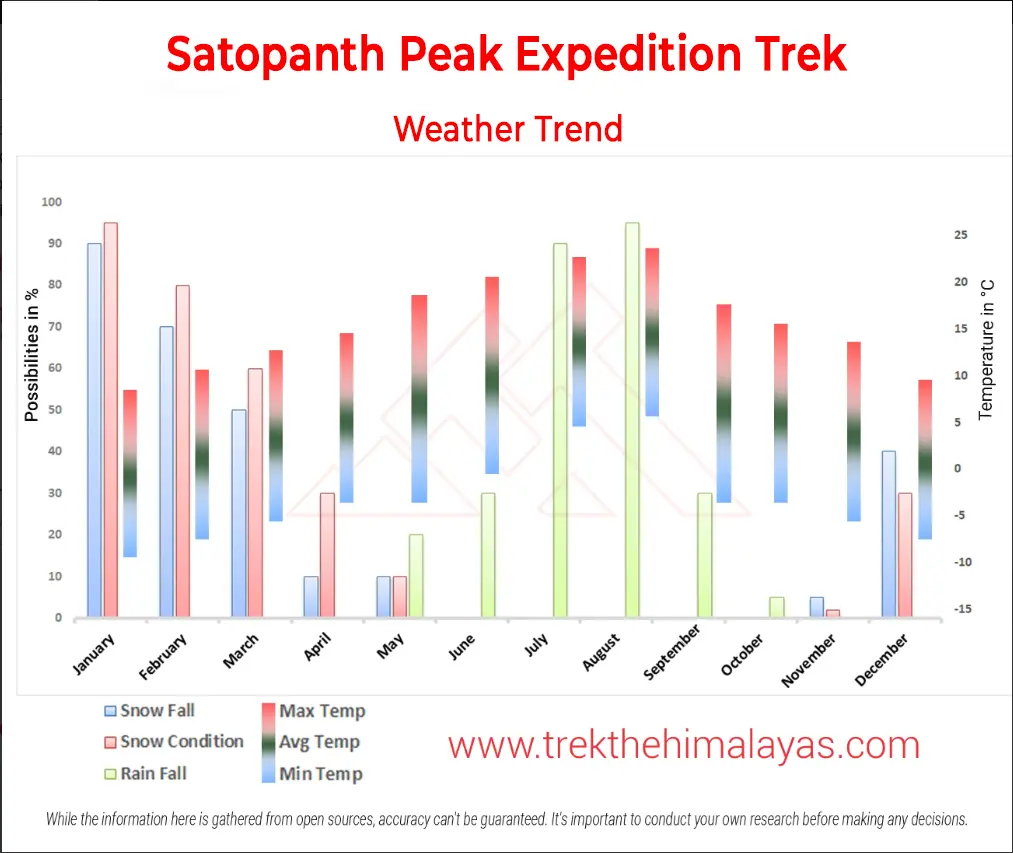
The best time to attempt the Satopanth Peak Expedition is during the pre-monsoon months of May-June and the post-monsoon months of September-October. During these periods, the weather is relatively stable, and the snow conditions on the peak are more favorable for climbing.
In the summer months, the weather is usually clear, and has the best views of the surrounding peaks. The post-monsoon season also provides beautiful views but with less chance of sudden rainfall. Avoid the monsoon season (July-August), as heavy rains can lead to unstable terrain, avalanches, and the risk of getting stranded.
Preparation for the Satopanth Peak Expedition involves a combination of cardiovascular fitness, strength training, and altitude training. Here’s how you can prepare:
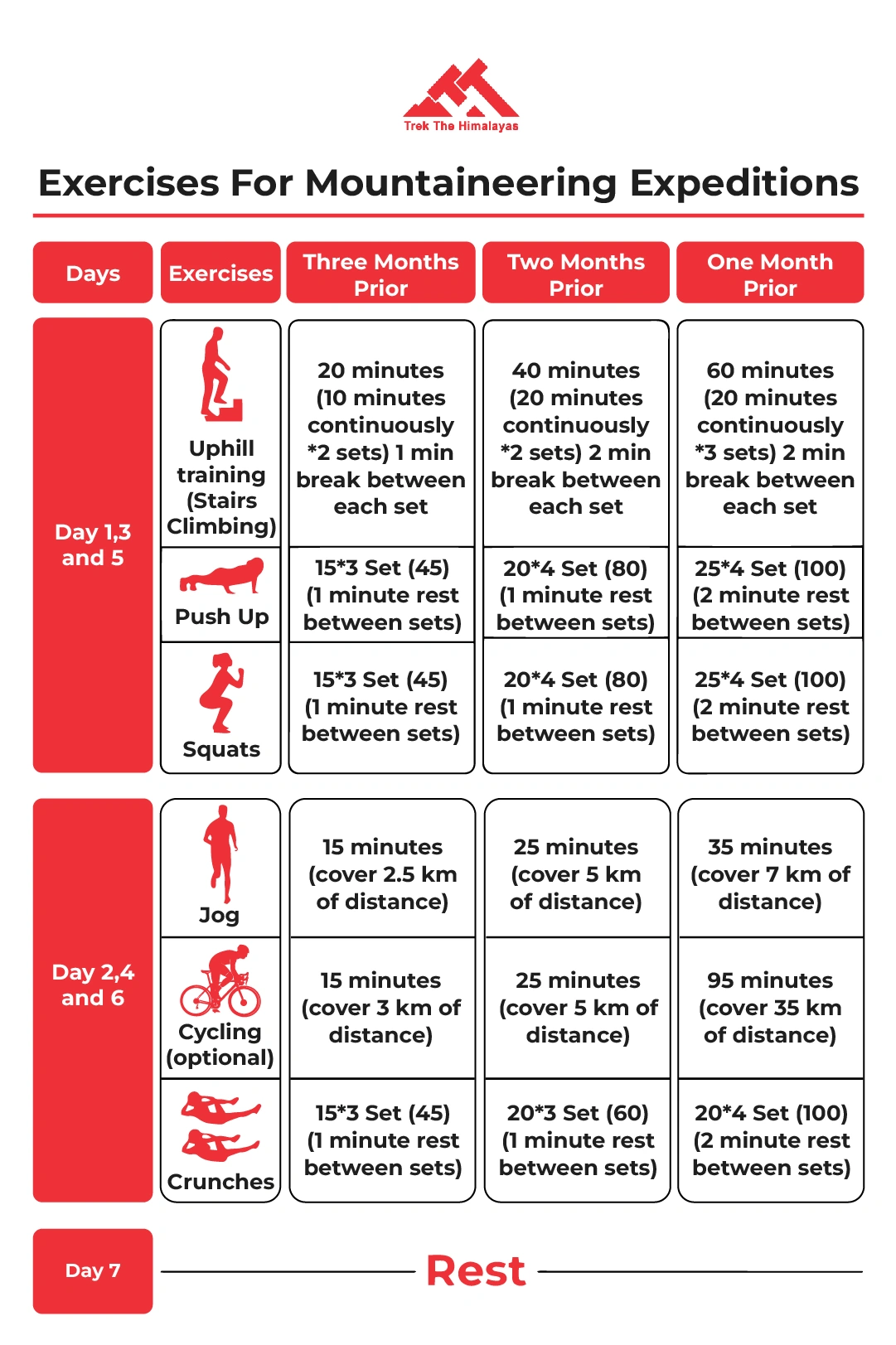
Cardiovascular Fitness: Focus on building your endurance through long-distance running, cycling, and swimming. Aim for at least 3-4 cardio sessions a week to enhance your stamina.
Strength Training: Strengthen your core, legs, and upper body through exercises like squats, lunges, planks, and push-ups. Focus on building muscle endurance for carrying a backpack and climbing steep inclines.
High-altitude Training: If possible, try to train at higher altitudes to simulate the conditions of the Satopanth Peak climb. Alternatively, use altitude training masks or seek out high-altitude hikes to prepare your body for reduced oxygen levels.
Climbing Practice: If you don’t have previous mountaineering experience, take some basic climbing courses to learn how to use ice axes, crampons, and ropes. Practice climbing with these tools in controlled environments like glaciers or climbing gyms.
Given the technical nature of the expedition, you’ll need specialized mountaineering gear. Here’s a list of essential equipment:
Clothing: Layered clothing for warmth, including thermal base layers, fleece jackets, waterproof outer layers, and insulated jackets.
Footwear: High-quality, waterproof trekking boots with stiff soles for glacier walks and climbing.
Technical Gear: Crampons, ice axes, climbing ropes, harness, carabiners, and a helmet.
Other Essentials: trek poles, first aid kit, sunscreen, sunglasses, and personal hygiene items.
Backpack: A durable, comfortable backpack to carry your gear, including hydration systems.
At TTH, we provide all the essential climbing gear such as ropes, technical equipment, harnesses, carabiners, crampons, snow boots, and helmets to ensure your safety and success on the climb.
Yes, previous mountaineering experience is highly recommended for the Satopanth Peak Expedition. You should be familiar with basic mountaineering techniques such as using an ice axe, self-arrest, and belaying.
If you have no prior experience but are keen to take on the challenge, we recommend completing a mountaineering course before attempting this peak. Non-Indian citizens must have successfully climbed at least one peak above 6,000 meters to be eligible. This helps ensure you're prepared to handle the technical aspects of the expedition.
Yes, the Satopanth Peak Expedition is supported by experienced guides and a technical team. It is highly recommended to attempt this climb with a professional trekking organization that has prior experience in handling 7,000-meter expeditions. A peak like Satopanth requires knowledge of technical climbing, glacier travel, crevasse rescue, and fixed rope setups.
At TTH, we ensure that a highly skilled team of mountaineering-certified guides, technical staff, and high-altitude support members accompany you throughout the expedition. Our team handles rope fixing, route navigation, and safety checks, while also helping you stay motivated and informed at every step.
Yes, the Satopanth Peak Expedition is supported by experienced guides and a technical team. It is highly recommended to attempt this climb with a professional trekking organization that has prior experience in handling 7,000-meter expeditions. A peak like Satopanth requires knowledge of technical climbing, glacier travel, crevasse rescue, and fixed rope setups.
At TTH, we ensure that a highly skilled team of mountaineering-certified guides, technical staff, and high-altitude support members accompany you throughout the expedition. Our team handles rope fixing, route navigation, and safety checks, while also helping you stay motivated and informed at every step.
Yes, climbing Satopanth Peak requires official permits and clearances from authorities. At TTH, we take care of all the necessary permits and clearances for you, ensuring a smooth and hassle-free expedition. You can focus on your climb while we handle the paperwork!
The entire Satopanth Peak Expedition takes around 22 days from arrival to departure. This includes travel days, acclimatization, summit attempt, and return. Multiple acclimatization days are built to ensure a safe climb. The summit push usually takes place between Day 8 and Day 18, depending on the weather. After the summit, you descend and return to Dehradun. The itinerary is thoughtfully planned to give climbers the best possible chance at success while prioritizing acclimatization and safety.
Climbing Satopanth Peak is a high-altitude expedition that comes with its fair share of challenges. The most notable is the altitude itself. At over 7,000 meters, the air is thinner, and your body needs time to adjust gradually. Acclimatization becomes very important. You’ll also encounter long glacier walks, sections with deep snow, and technical patches where you may need to use fixed ropes.
Weather conditions can change quickly at this height, so staying flexible and well-prepared is part of the experience. With the right guidance, proper acclimatization, and team support, these challenges can be managed safely.
During the Satopanth Peak Expedition, you’ll be provided with nutritious and energy-dense meals, specifically designed to meet the needs of climbers at high altitudes. Expect hearty meals like oatmeal, eggs, toast, porridge, fruits, rice, lentils, and vegetables. Meals often include comforting staples such as soup, pasta, and dal. At times, you might also get to enjoy traditional Himalayan dishes.
Food is usually vegetarian, and Dal Bhat (rice, lentils, and vegetables) is the most nutritious and commonly eaten meal by climbers. The food is designed to replenish your energy stores, keeping you fueled and ready for the climb.
Yes, you will receive a certificate from TTH after successfully completing the Satopanth Peak Expedition. This certificate recognizes your achievement of reaching high altitude and completing one of India’s most challenging climbs. It also reflects your endurance, mountaineering skills, and dedication, which can be valuable if you plan to pursue further expeditions or outdoor certifications.
Your expedition team will carry oxygen cylinders, first aid kits, and satellite communication devices. Daily health checks are done at base and higher camps. Rope fixing, load management, and weather monitoring are continuous. Evacuation plans and emergency protocols are always in place for high-altitude risks like HAPE, HACE, or injuries.
Absolutely. Women’s safety is a top priority for us on all treks and expeditions, including Satopanth Peak. We ensure that female climbers feel safe and comfortable throughout the journey. All our campsites have separate tents for women when needed, and our expedition leaders and staff are trained to maintain a safe and respectful environment. Over the years, many women, both solo and in groups have successfully completed this expedition with us. You're in capable and supportive hands from start to summit.
No, Satopanth is not for first-timers. You must have done at least one or two technical expeditions above 6,000 meters. For Indian citizens, a Basic Mountaineering Course (BMC) is required, while for non-Indian citizens, you must have successfully climbed at least one peak over 6,000 meters. These experiences will prepare you for the technical aspects of the climb. It’s important to respect the mountain and gain enough experience before stepping into a 7,000-meter expedition.
Recently Visited Treks