
25 February 2026

If you are planning to go on a journey that offers a purely raw Himalayan beauty and an inviting solitude, Bharadsar Lake is exactly the destination that you are craving for. Nestled in the remote folds of Chamba district of Himachal Pradesh, the Bharadsar Lake Trek is an incredibly rewarding journey into the heart of the Himalayas. Completely detached from crowds, this trek takes you through pristine alpine meadows, dense forests, typical mountain villages, and a stunning lake that settles just beneath snow-laden peaks.
Bharadsar Lake Trek is situated at an altitude of approximately 4,300–4,400 meters (14,100–14,400 ft) above sea level. It is a moderate to difficult journey and is around 35 to 45 km long depending on the route. This trek is ideal for experienced and intermediate trekkers who are comfortable with long walking hours and gradual altitude gain.
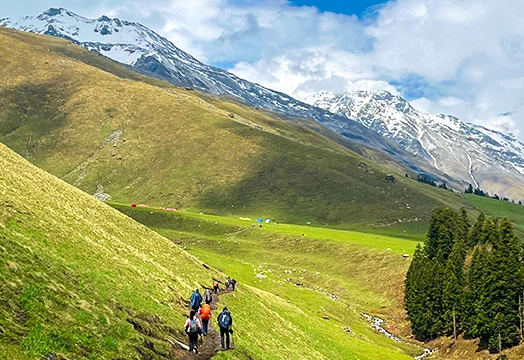
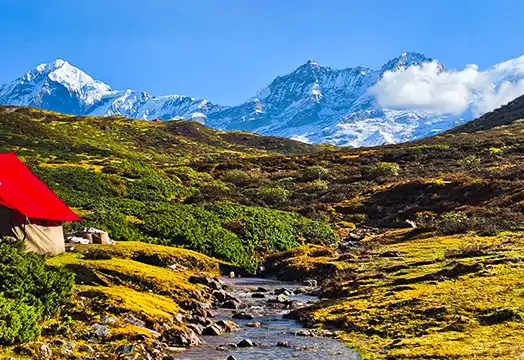
The untouched wilderness of Bharadsar Lake makes it truly special as it receives very few trekkers throughout the year. The thick forest patches of pine and oak along the trail make it even more attractive. The traditional settlements that lie on the route still carry their old-world charm. With rising altitude, forests turn into wide green alpine meadows. During summer and autumn months, these high-altitude grasslands bloom with wildflowers, creating a strikingly vivid contrast against a jagged mountain backdrop. The crystal-clear waters of Bharadsar Lake reflect the surrounding peaks like a mirror; also, the calm and silent atmosphere at the lake is deeply peaceful.
The interesting story of Bharadsar Lake is preserved through local folklore, pastoral traditions, and regional culture. The name “Bharadsar” is believed to be derived from “Bharad” (possibly linked to local deities or clans) and “Sar”, meaning lake in Sanskrit and many Himalayan dialects.
The locals of this region believe that the lake is sacred and is guarded by Nag Devta (Serpent Deity). As per another local folklore, the lake is named after the Baraadsar Peak, believed to be an abode of Lord Shiva. It is also known as “Wish-Fulfilling Lake” and pilgrims visit it with genuine wishes in their heart.
Day 1: Drive from Dehradun to Dhaula
The journey begins with a scenic drive from Dehradun to Dhaula, which takes approximately 12 hours depending upon the road conditions. The winding route takes you through a series of beautiful hill stations such as Mussoorie, Purola, Mori, Naitwar, and Himri. Get ready to be surprised by the breathtaking pine forests when you drive past Puraola, while the drive along the Tons River after Mori is equally thrilling if not more.
Himri, a mesmerizing mountain village, is the base camp for the Bharadsar Lake trek. The Dhaula Village is approximately 4 km ahead of Himri and the crucial starting point of the Rupin Pass Trek. Situated on the banks of the Rupin River, Himri is located at an altitude of 4,820 ft and serves as a remarkable campsite that offers a beautiful view of pine and other coniferous forests.
Day 2: Trek from Himri to Saaru Tal via Bitri Village
The destination of the day is the little village of Bitri, which stands on top of the mountain-ridge above Himri. Bitri is reached by a steep 2,700-ft climb which starts within the pine forests of Himri. The trail climbs quickly. After approximately an hour of climbing, just over 1,800 ft., you will then arrive at your first rest point, Kujraili.
The trail then branches to numerous directions. You can ask men from the village about where to go, or you might take the wrong road. The sources of water are practically nonexistent; bring at least two liters. The trek lasts roughly for four hours and ends at the village of Bitri, whose population is slightly over 100 families.
As you come into Bitri, children greet you with waving hands. A stroll through the old wooden houses will take you to the village centre. A temple is located next to a small school. It is an open-air school, with an outside blackboard.
One of the major attractions of Bitri is the temple. It is a wooden structure, and its doors are adorned with shields and there is a Pagodan storehouse next to it. The temple is constructed in the traditional Kinnauri fashion with a heavy influence of the neighboring Kinnaur, even though it is located in Uttarakhand. Women are not permitted to go inside the temple; this may be disappointing to the trekkers. The deities are Biren Nag and Mahasu.
There is a Moruban tree just outside the village that gives shade and offers a good lunching place. Then there is another walk for one hour to the next campsite at Saaru Taal. The camp site is a large meadow with a small lake at its center. The lake itself remains dry most of the year and the closest water source is a stream that is almost one kilometer away.
Day 3: Trek from Saaru Taal to Badang
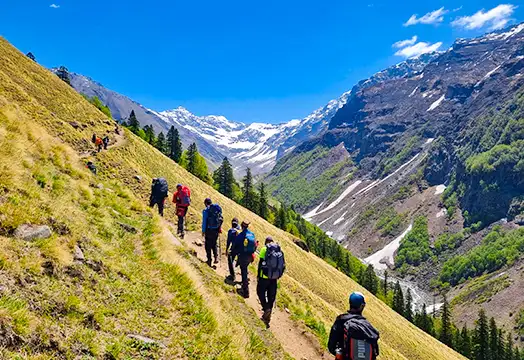
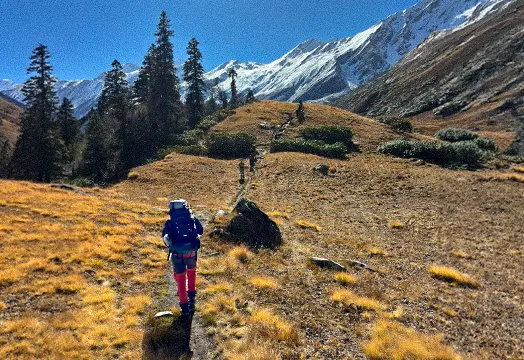
The day-3 starts early as usual and after breakfast, there is another steep but enjoyable climb to Badaang. It is a beautiful campsite that lies on a mountain slope and is surrounded by dispersed oak trees. The hike of the third day is a moderate trek with a distance of approximately 7 km with an overall altitude gain of around 2200 ft. After hiking for just over an hour on a rugged trail and stiff climb, you come across a small mountain stream. Moving past the stream, you enter a dense forest of pine and cedar trees.
The trail through this forest is well-marked with stone pedestrians and it offers an easy walk all along. However, the final 1.5 to 2 km section before Badaang, the route becomes a bit steep. This stretch is rich in biodiversity where you can spot Himalayan Langurs and multiple varieties of birds. Finally, you reach the Badaang campsite, which is a stunning meadow and is surrounded by pine and cedar trees. There is a fresh water stream just nearby to this campsite.
Day 4: Badang to Dhal Dhar
On day-4, the journey between Badang and the next campsite at Dhal Dhar is a strenuous and long one. After having breakfast, you will trek your way through the lush tree line of oak and pine just beyond the campsite. After walking for almost three hours along the trail through the dense forest and taking halts after a few stiff climbs, you will approach a ridgeline, while the trees thin out.
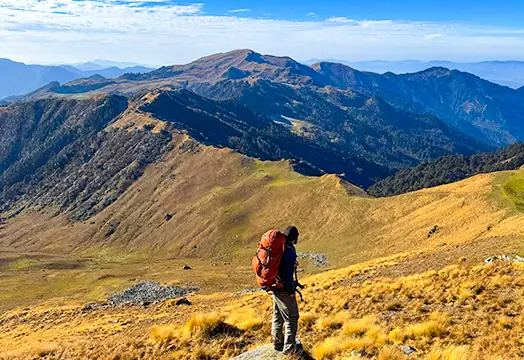
After a short distance the trees open into meadows, and here you will see that you are over 1,000 feet higher than Badaang. This is Vijay Top; Masundha Dhar is approximately a kilometer away from it. At Masundha Dhar the path turns into a picturesque ridge walk, and at this juncture two mountain crests connect with each other. Approximately twenty minutes into the meadows the landscape is revealed in a dramatic manner. The lofty heights of Swargarohini, Bandarpoonch and Ralgan rise so splendidly in front of you.
On either side of the trail rhododendron bushes grow in full bloom. Another four hours of ridge walk will provide a panoramic view of the grandeur of mountains in virtually all directions. The trail from here gradually climbs from ridge to ridge, and it also offers a few short descents where you can take momentary rests.
There is the village of Liwadi in the distance. Dhal Dhar camp is perched in a small valley, and the other side of the valley is seen covered by white rhododendron flowers. Along the trail there is no water. Fatigue and dehydration may strike in an extremely short time after over five hours of exposed ridge walking with no tree cover. Bring with you a minimum of 2 liters of water that you obtained in Badaang and use sparingly.
Day 5: Trek from Dhal Dhar to Dev Bhasa
The Trek on the fifth day is short and relaxing and will take no more than 2 hours at a normal pace. There is a climb for almost half a kilometer with an elevation gain of 500 ft. From here, a gentle descent will take you straight to the campsite.
The campsite of Dev Bhasha is nicely perched on a small plain that connects two mountains. This is a rocky patch but also offers a remarkable view of surrounding peaks and valleys. The mountain summits that are visible from Dev Bhasha include the Gangotri Range. As the campsite lies on a barren slope, the nights usually turn windy and cold. The water source is around 2 km away from here.
Day 6: Trek from Dev Bhasa to Bharadsar Meadow
The journey between Dev Bhasa and the Bharadsar Camp is definitely the most tedious and strenuous part of the first six days of this adventure. The Bharadsar campsite can be reached through two routes. The lengthier path branches to the left side of the mountain, circles it and then comes right to reach Bharadsar. The shorter route, on the other hand, is a steep climb through a pass and goes straight to the campsite. Initially, the trail is rocky with boulders, and there are chances of witnessing snow, too.
After walking for approximately 5 hours on the longer path, you get to a crossover point of a ridge. The Bharadsar campsite is still 3 hours away from here. The trail along the other side of the ridge poses a special challenge. It is composed of superimposed rocks which are mixed with the snow; so, traveling along it becomes an unsafe affair.
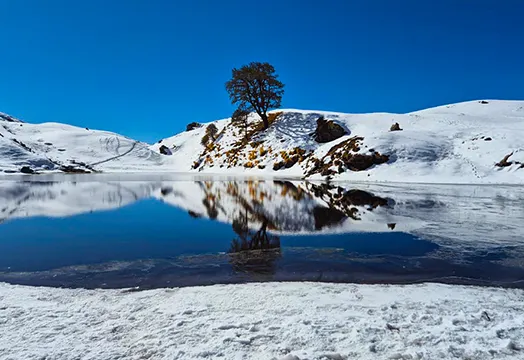
You would be able to have a glimpse of Bharadsar Lake from an elevated point above the campsite. The lake is partially frozen and appears dark, which is actually the reflection of the shadows of the surrounding mountains. The lake takes another four-hour walk to reach across the rugged and challenging terrain.
The landscape on the other side of the ridge is as rough and barren as it gets, nearly inhospitable. And the winds blowing down the hillside are bone-chilling. Bharadsar Camp has neither water nor firewood to be found in the meadow. The only source of water available is snow, which has to be melted to be used. You must also bring enough fuel not just to cook but to melt snow to fulfill your water needs.
Day 7: Trek from Bharadsar meadow to Bharadsar Lake and back to Dev Bhasa
After spending the night at Bharadsar Meadow campsite, day-7 is the day to visit the Bharadsar Lake. The fact is, it is not visible from the campsite; the only view you had of the lake was from the ridge you came from earlier. The trail to the lake involves rocks and moraines, which demands you to tread carefully.
After visiting the lake and soaking in the tempting solitude, you have to retrace your steps to the campsite; and then straight to the ridge-top. There is a chance that the path is covered with snow, so you have to walk accordingly.
From the ridge, the trail descents till the Dev Bhasa camp, which is steep and slippery. It will be better to take the shorter ridge route that takes approximately 3 hours to go from Bharadsar camp to Dev Bhasa.
Day 8: Dev Bhasa to Upper Rehala
The trek on the eighth day requires you to walk along a steep path from Dev Bhasa to Upper Rehala. After having breakfast, you have to begin your journey by retracing your steps to Dhal Dhar, which takes just a little over an hour. In order to get Upper Rehala, the path from here branches off to the left side of the original route. The initial section of this trail contains loose stones and slippery rocks, making the downward journey a bit difficult and requires attention.
After walking for around one hour down the mountain, you will come across the first water stream. Here you can refill your water bottles. You will reach another water source after roughly one hour, and then the path enters open meadows. Moving further along the trail, you will come across a beautiful pine forest.
Around half an hour along the forested train, the trees begin to thin out, while the trail winds through terraced fields where seasonal Himalayan crops are cultivated. The Upper Rehala campsite is located at an altitude of 8,840 feet, and is perched at a much lower height than the previous camps. The village life begins to give its presence and herds of sheep/goats appear grazing on the slopes around this campsite.
Day 9: Upper Rehala to Sankri via Jhakhol
On the ninth day as well, you will continue your downhill walk towards Sankri. The trail takes you along the cold and fresh mountain streams. After an hour’s walk on this path, you will reach the actual Rehala Village. Crossing a couple more villages downhill, the same trail takes you all the way to the Supin River, which is joined by another river, Obra. At this junction, you can find a few shops to have tea and snacks. After relaxing for some time here, the path takes another couple hours to reach Jakhol. From Jakhol, you can catch a vehicle to get to Sankri, which is around 16 km from here.
Day 10: Drive from Sankri to Dehradun
This long and rewarding Himalayan adventure concludes on the 10th day as you will drive back from Sankri to Dehradun. While coming back from this momentous trek, some of the most delightful memories will definitely cross your mind. It is almost difficult to forget even a splinter of these awesome memorable moments that you spent during this journey.
To enjoy an immersive journey to Bhadrasar Lake, you need to trek during the ideal conditions, which are the months: May - June and September – October.
During the months of May and June, the summer season in full blow turns the trails alive. On lower campsites where treks begin, you will witness the terraced fields and greenery. The areas in slightly higher altitudes are adorned by blooming rhododendron flowers. The forests become stunningly beautiful. The sky is crystal clear and allows breathtaking views of Bandarpoonch and Swargarohini Peaks. The average temperature during the day is 10 to 12 degrees, while nights range from -2 to 2 degrees.
The autumn season that comprises September and October transforms the landscapes vibrantly. The atmosphere turns extremely clear after the monsoons, making views sharper and clearer. The trail remains dry and leaves acquire different hues such as golden, brown, yellow, red.
To reach the beautiful Bharadsar Lake Trek, you have to get to the capital city of Uttarakhand – Dehradun. It is properly connected by bus, train, and flight from New Delhi and other prominent cities of India. From Dehradun, your journey to Dhaula or Himri will begin in the morning. The drive takes around 7–8 hrs and passes through beautiful pine forests, apple orchards and small villages.
If you are coming:
Bharadsar Lake Trek is situated at an altitude of approximately 4,300–4,400 meters (14,100–14,400 ft) in Uttarkashi district of Uttarakhand, India. It sits on the border of Uttarakhand and Himachal Pradesh between Rupin and Supin Valleys.
Bharadsar Lake Trek has a lot of attractions to offer for visitors. During recent times, it has gained a lot of attention due to its off-beat and less-explored trails. The key highlights that you can enjoy on and around this trek are: meadows of Dev Bhasa, Dhal Dhar Ridge, Baradsaar Base, Maldaru Tal, Masunda Dhar.
The journey to Bharadsar Lake is usually considered a difficult trek. It is long and adventurous, so not suitable for kids and elderly. Beginners with great fitness can go on this trek with proper guidance, gear and preparation. Weather can be unpredictable, so proper acclimatization is important.
The best time to do this trek is summer (May and June), and autumn (September and October). During this time, the trails at different sections seem to be decorated with rhododendron flowers during summers; while during fall months, the atmosphere turns vibrant with golden, brown, yellow and red colors. The air is crisp, weather is stable, daytime temperature is 10 to 12 degrees, and night temperature ranges from -2 to 2 degrees.
25 February 2026

Trek updates, stories & mountain insights.
Tips and insights for every trekker.

Winter is almost here, and you're still planning on following the same routine. Sitting in a blanket, sipping on hot tea, and binge-watching your favorite movies.
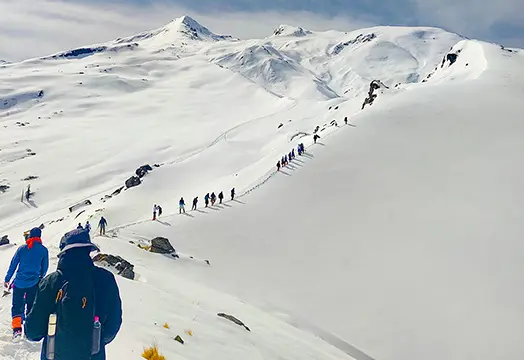
Every season in the Himalayas has its own way of showing off the mountains, but winter reveals a different side of them, one that feels like a whole new world.
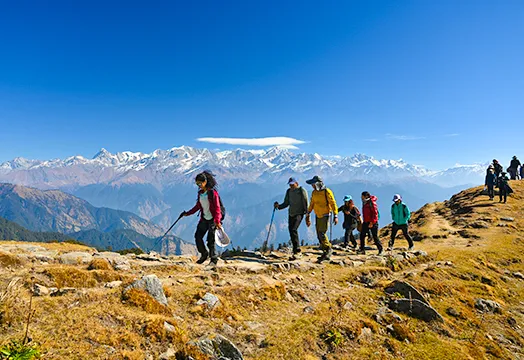
As monsoon season comes to an end, it washes away all the dust and haze that remains in the valleys throughout the summer, and then?
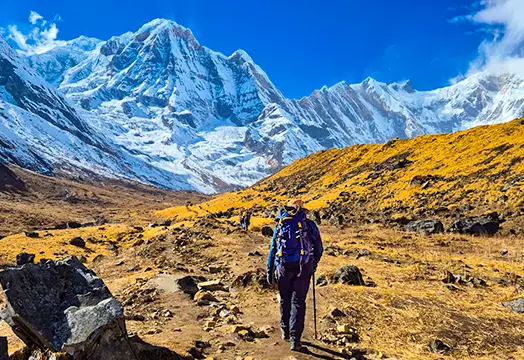
Located in north-central Nepal's Gandaki Province, Annapurna is the world's 10th highest and one of the most challenging mountains on the planet. Its height rises to 26,545 feet. Yet reaching Annapurna base camp is a far more accessible adventure, drawing trekkers from around the world every single season.
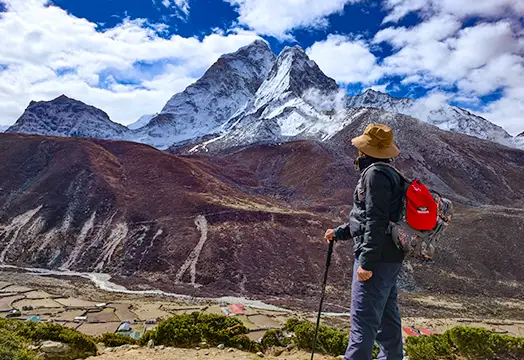
What does it feel like to stand on a trail where the mountain before you is worshipped as a goddess? For most of us, it's an adventure. But for the local communities who live in its shadow, it's something closer to faith. That mountain is Everest.

Over the last few decades, trekking has driven a profound shift: rural economies and local communities are reaping direct and indirect benefits.

Hiking teaches you to fall in love with the outdoors. Trekking teaches you to endure it. Mountaineering teaches you to respect it completely.

There are only a handful of Himalayan regions that hold profound spiritual significance as well as immense natural beauty. The Gaumukh Tapovan trek is one such destination that wonderfully combines adventure, divinity, and extraordinary Himalayan beauty.

What if a trek could leave you with more questions than answers? What if, after days of trekking, you reach a lake filled with centuries-old human skeletons?

Every year, every season reveals a new side of the Himalayan range. Be it trails covered in colourful rhododendrons or trails transformed into a lush green paradise, each season offers some of the most mesmerizing views of the Himalayas.
26 Oct 2026
25 Oct 2026
24 Oct 2026
23 Oct 2026
22 Oct 2026
21 Oct 2026
19 Oct 2026
18 Oct 2026
17 Oct 2026
16 Oct 2026