
2 February 2026
The Bansi Narayan Trek is located at an altitude of approximately 3,600 meters (11,700+ ft) in the Urgam Valley of the Chamoli district in Uttarakhand, India. Beautifully nestled in the isolated Himalayan environment, this trek is popular for its breathtaking views of Nanda Devi mountain range, thick rhododendron forests, evergreen valleys, and alpine meadows.
Apart from its serene and poised environment, the Bansi Narayan Trek is known for its prominent landmark - Bansi Narayan Temple - dedicated to Lord Vishnu. This 8-th century architecture is still standing resolutely in its place and attracts many pilgrims and devotees. It is located in the vicinity of Nandi Kund, a high-altitude alpine lake having strong spiritual meaning. The temple is perched on a slope of a hill that lies around 10 Km ahead of Bansa - the last village in Urgam Valley.
This reclusive trek is beautifully surrounded by dense forests of oak and rhododendron with a rich biodiversity. On a lucky day, it offers amazing sightings of rare Himalayan flora and fauna. Unlike many high-altitude treks that are usually thronged by tourists, the Bansi Narayan Trek is extremely peaceful, tranquil, and truly splendid. During winters, the trek experiences heavy snowfall and the surrounding region is blanketed by a thick layer of snow.
The Bansi Narayan Temple has deep historical and divine roots. Locals perform a community “Pooja” once a year on the auspicious day of Raksha Bandhan, but it is open for devotees throughout the year who want to take blessings.
The temple has an interesting history behind it that has been passed on through generations. There was a time when the entire world was ruled by King Bali and his relentless conquests perturbed ‘Devtas’. Exasperated, they sought help from Lord Vishnu. Moved by their request, Vishnu attained the avatar of a dwarf Brahman, Vamana.
It was believed that King Bali was very generous, too. So, Lord Vishnu went to him and asked for land in just 3 steps. The king agreed. Then Lord Vishnu covered the whole earth in the first step; in the second step, he covered the whole sky. There was no place left for the 3rd step; then King Bali offered his head and Lord Vishnu put his foot on his head and eventually sent him into Patal lok. Bali requested the Lord to accompany him to this new place.
When Goddess Lakshmi couldn't find Lord Vishnu at his abode, she consulted Narad Muni about Vishnu’s whereabouts, and then he narrated the whole incident. Narad Muni then suggested to her to travel to Patal Lok on a full moon night of the Shravan month and tie a Raksha sutra on king Bali’s wrist. It is believed that finally Bansi Narayan Temple was the place where Lord Vishnu reappeared from Patal Lok.
Day 1: Arrive at Joshimath / Helang
If you have chosen to travel by train, you need to reach Dehradun or Haridwar either early in the morning or the night before. Shared cabs depart from the railway station at the early hours and are priced at about ₹600 to ₹800 per seat.
Alternatively, you can board an overnight bus from Dehradun to Joshimath.
The journey starts at the village of Devgram (6,614 3 ft) in the Urgam Valley.
Day 2: Drive to Devgram. Trek to Mulakharak
This journey begins at Devgram and is marked with an easy to follow trail that takes you to Bansa. After approximately 20 minutes, there is a mobile tower from where the sight of the Urgam Valley fades slowly. The trail ascends slowly till you come to Bansa (7,277 ft), which is about an hour walk away at Devgram.
After walking for around 15 minutes on a well-marked pedestrian, you arrive at Urba Rishi temple, which is approximately 7,705 feet. Traversing the route for another 15 to 20 minutes to Mulakharak, you reach the first water source and you can refill your water bottle here. From this place onward, the trail becomes almost vertical and zig-zag.
Further along the top, the forest gives way into the wide Mulakharak meadow. At one corner stands a shepherd hut. From this spot beyond the horizon, you can see panoramic views of the Kedar Range with peaks such as Barmal, Nanda Devi, Trishul and Nanda Ghunti looming in the backdrop. The scenery is especially compelling during sunset.
Jagdi Mata (Bhagwati Devi Temple) is located on a small hill 9,042 ft above the sea level. You spend the night in the Mulakharak campsite.
It is important to note that there is no water source precisely at the campsite, but you can find one 20 to 25 minutes away, where water is available 22/7.
Day 3: Mulakharak to Bansi Narayan temple
On Day-3, you wake up early in the morning and have your breakfast right away. Around 7:30 AM, you will leave for your destination - Bansi Narayan Temple. After walking for a few minutes, the trail turns a little steep and rugged.
Begin to walk towards the Bhagwati Devi Temple. The trail crosses a beautiful grove of green oak trees. Continue going up after the temple, then after about 20 minutes you will locate a source of water. It is an important resting place, and the half-way of the journey between Devgram and Bansi Narayan (9,606 ft).
Continue up the hill 10 more minutes to arrive at the second body of water at 9,705 ft. After that the trail grows steeper, ascending after a space of 25 minutes to the ridge known as Berjik Dhaar. This breathtaking ridge is elevated to a level of 10,115 ft. Then the route turns towards the west. Prayer flags can be seen pointing to the Chetarpal Mandir, which is at 9,980 ft.
After leaving the temple and walking for about 20 minutes, the trail takes you to a clearing just beyond the tree line. After crossing this clearing, a forest dominated with rhododendron trees continues for some time. Another half an hour walk along the path, you arrive at Nokchuna Dhar, which is situated at an elevation of 10,991 feet. It’s yet another known landmark with Ganesh Temple. From here you can get a mesmerizing view of the opposite side of the valley.
As you carry on with your climb toward Bansi Narayan Temple, you can witness a series of cave-like shapes along the right-side slope of the mountain. These caves could be the habitat of wild Himalayan animals such as bears, foxes or leopards. This point lies at 11,106 ft.
The Bansi Narayan Temple is still one hour away from here. Once you reach the temple, you will get a breathtaking view of the surrounding area. From here, if you take a 5-minute hike, you will reach a meadow at 11,772 feet, which is a perfect spot for setting up camp.
Backstory of Chetrapal Mandir: The legend goes like this: Chetrapal Bhumiyal was once deeply worshipping Lord Shiva at an isolated place. When demons learned about this, they tried to disturb him; and to ward them off, he started ringing a bell loudly. The fierce sound chased the demons away, and in the process he received Lord Shiva’s blessings.
Day 4: Explore the area around Bansi Narayan Temple
On day-4, you will have ample time to explore this area with numerous vantage points to visit. Around 2 hours from the summit, there is a high-altitude alpine lake, Chota Nandi Kund, which is worth stopping by. Right opposite to this mountain, you can see the stunning Kedar Range with Kedarnath and Kedar Dome standing upright.
Day 5: Bansi Narayan to Devgram
On this final day of trekking, you have to retrace your path and descend all the way back to Devgram. On your way back, you can take a detour and visit Kalpeshwar Temple before getting to Devgram. This temple has profound cultural and spiritual significance as it is known as the fifth Kedar in Panch Kedar.
Backstory: Panch Kedar is located deep in the valley of Urgam that is surrounded by dense forest. The sanctum-sanctorum lies under a huge caved granite rock where Lord Shiva is worshipped in the form of a tree (Jata). The legend has it, Lord Shiva was offered water from a pool situated at this same place. The vessel in which water was given was one of the 14 gems that were churned out from the sea. Also, just beneath the temple, Kalpaganga River flows and is known as Himawati.
The priests that serve in this temple come from the Negi family right from the beginning. They are also locally known as Bhalla.
The best time to visit the Bansi Narayan Temple is during spring, summer and autumn seasons. From March to June, the forests are adorned with enchanting red and pink flowers of rhododendrons. This is the time when the weather is fine, clear, bright, and pleasant.
The months of September and October offer exquisite views of sunrise and sunsets along with golden, brown, and red hues spreading over the forests. The meadows in the autumn seem beautifully decorated with wildflowers, and a good possibility of spotting wildlife.
The months of July and August are mostly avoided as this region is prone to landslides during monsoons. The winters, on the other hand, are cold and snowy. Trekkers who want to enjoy snow-covered landscapes, then winters are apt for them.
When coming on a train, you should try to reach Haridwar or Dehradun very early in the morning or the night before. Outside both railway stations in the morning, one can find shared taxis, which can cost around Rs. 600 to Rs. 800 depending on the seat.
An overnight bus can also be taken from Dehradun to Joshimath or Tapovan. There are daily buses that operate between Haridwar and Badrinath. You have to get into any of these and get off at Helang, which is the last bus station before Joshimath on Badrinath road.
The trekking journey starts in Devgram (6,614 ft), a village in the Urgam Valley. And at Helang you have to get a common cab with Devgram. You should be prepared to wait because these cabs usually do not move until there are enough people in the vehicle.
The Bansi Narayan Trek is located at an altitude of approximately 11,700 feet in the Urgam Valley of the Chamoli district in Uttarakhand, India. It is beautifully nestled in the Garhwal Himalayas and has deep spiritual significance for the native people.
Bansi Narayan is an easy to moderate trek with certain sections turning a bit difficult during monsoons and winters.
Although it is a peaceful and stunning trek, summer and spring months are the best in order to visit Bansi Narayan Temple. These days offer warm days and cold nights, while the weather largely remains pleasant.
You can drive to Joshimath from Rishikesh or Dehradun. This is a 9-hour journey. From Joshimath, you reach Devgram village via Urgam Valley. Devgram is the base for the trek. Or you can board a bus to Joshimath or Tapovan. Trekking starts at Devgram further uphill to the temple.
2 February 2026

Trek updates, stories & mountain insights.
Tips and insights for every trekker.
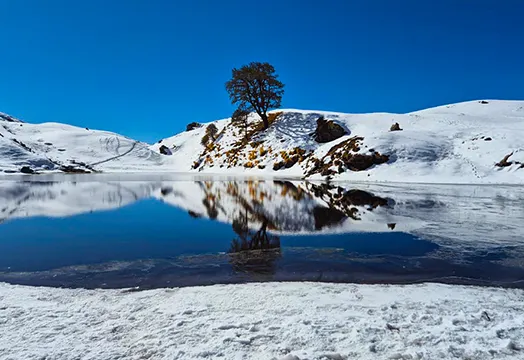

Winter is almost here, and you're still planning on following the same routine. Sitting in a blanket, sipping on hot tea, and binge-watching your favorite movies.
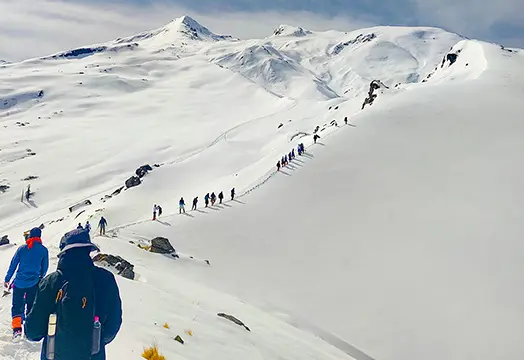
Every season in the Himalayas has its own way of showing off the mountains, but winter reveals a different side of them, one that feels like a whole new world.
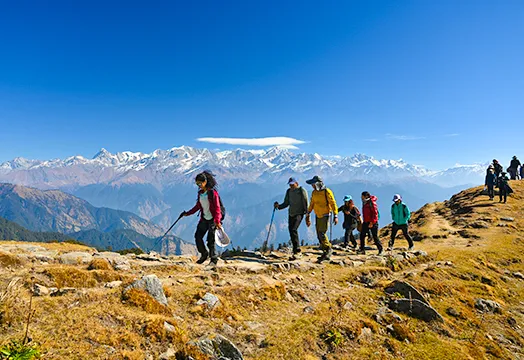
As monsoon season comes to an end, it washes away all the dust and haze that remains in the valleys throughout the summer, and then?
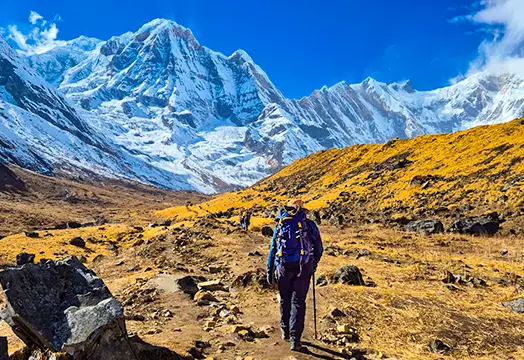
Located in north-central Nepal's Gandaki Province, Annapurna is the world's 10th highest and one of the most challenging mountains on the planet. Its height rises to 26,545 feet. Yet reaching Annapurna base camp is a far more accessible adventure, drawing trekkers from around the world every single season.
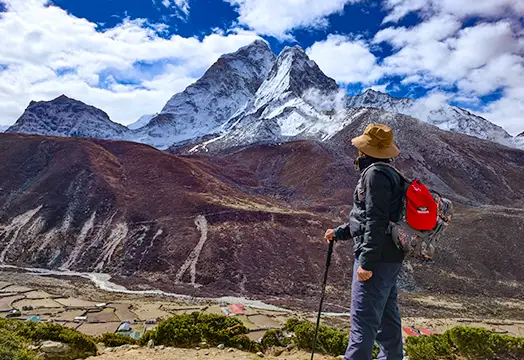
What does it feel like to stand on a trail where the mountain before you is worshipped as a goddess? For most of us, it's an adventure. But for the local communities who live in its shadow, it's something closer to faith. That mountain is Everest.

Over the last few decades, trekking has driven a profound shift: rural economies and local communities are reaping direct and indirect benefits.

Hiking teaches you to fall in love with the outdoors. Trekking teaches you to endure it. Mountaineering teaches you to respect it completely.

There are only a handful of Himalayan regions that hold profound spiritual significance as well as immense natural beauty. The Gaumukh Tapovan trek is one such destination that wonderfully combines adventure, divinity, and extraordinary Himalayan beauty.

What if a trek could leave you with more questions than answers? What if, after days of trekking, you reach a lake filled with centuries-old human skeletons?

Every year, every season reveals a new side of the Himalayan range. Be it trails covered in colourful rhododendrons or trails transformed into a lush green paradise, each season offers some of the most mesmerizing views of the Himalayas.
21 Oct 2026
19 Oct 2026
18 Oct 2026
17 Oct 2026
16 Oct 2026
15 Oct 2026
14 Oct 2026
13 Oct 2026
12 Oct 2026
11 Oct 2026