Some journeys don’t require a road, just a willing heart. That is how this journey began.
A statutory warning,–“All those who plan to stay away from addiction, read the article with caution. It is likely to cause craving and may ultimately lead to addiction!”
My co-sister Malavika and I are nearly the same age. As we both entered the Fifth decade of life, some inner compass shifted. The unfulfilled dreams kept popping into their heads more frequently. We decided to live life a little more adventurously before it became too late. We decided to do a trek in beautiful mountainous surroundings. We started scouting around for information and managed to find a reputed Trekking Company, Trek The Himalayas. The next task was to narrow down the choice of trek based on the difficulty level. We decided on Kareri Lake Trek. This lake is nestled approximately 10,000 feet above sea level in the Dhauladhar range of mountains in Kangra District. The trekking period was scheduled for 3 days and associated with the difficulty level of Easy without snow and Medium if snow is there. We agreed on a summer trek in April hoping for no snow and started getting ready for it. Our husbands were unable to join us because of their work commitments, but they motivated us to live our dreams. Secretly we were happy about going ahead without our spouses. It gave us more liberty to spread our girly wings! We even contacted a few of our friends whom we thought would be interested in this trip.
Preparation now started at three levels. The first aspect was the logistics of booking the trek, the reservations to reach Dharamshala from where the trek would commence and the return journey. Since time, effort and money were being spent to reach Dharamshala we decided to spend a day before the trek enjoying Dharamshala and McLeodganj. After the trek, we planned to extend our holiday by a day in Yol. The second aspect was to buy the required trekking shoes, hiking poles, high UV index sunglasses etc as per the forwarded list from the trekking organisation. The third part was the most difficult one and that was to build a fitness level commensurate with the planned activity. For me, it became a round of Yoga, Gymming, Walking, Cycling and Swimming. Each day I tried to vary my fitness regime so that various groups of muscles could get activated. It would have been highly embarrassing to put in all that effort and money and be unable to complete the trek due to low fitness levels!
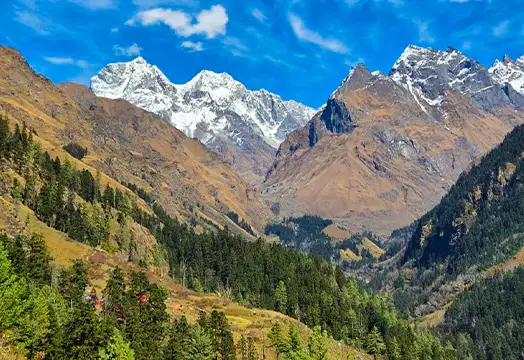
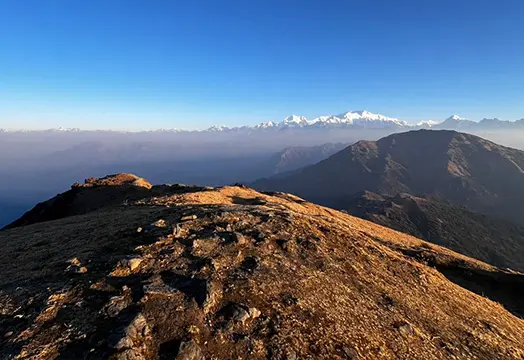
The day finally dawned for us to start our trip. Just before boarding the train from Delhi to Pathankot, one of the friends who had been contacted confirmed her presence on the trip. That was indeed a happy bonus. The next morning we reached Pathankot, picked up our friend and took a taxi to Dharamshala, where we checked into our guest rooms. The sight of the mighty Dhauladhars, covered in snow, was indeed very mesmerising. The day was happily spent exploring the Monasteries, Bhagsu falls, Bhagsunath Temple, charming cafes, Dharamshala cricket Stadium, War memorial, tea gardens and Kangra Art museum. We decided not to tire ourselves out before the trek and enjoyed a relaxed evening with each other.
Day 1

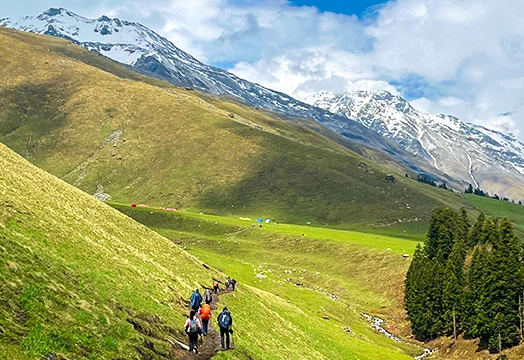
We reached the Dharamshala bus stand and were picked up from there by the TTH team leader at 10:00 am. We were introduced to the other trek members. It was a very heterogeneous group of 9 members along with 2 trekking guides. We were 5 ladies as compared to 4 men! 3 boys and a girl were students and besides the three of us, there was a man in his fifties and a woman in her forties. My co-sister and I were the eldest and were the “Aunties” of the group. However, that turned out to be an advantage, because when the others realised that this was our first-ever trek they always lent a helping hand. After a 2-hour scenic drive through hills and rivers, we reached Kareri village. This delightful little village at 6000 feet is at the foothills of the mountains and adorned with lush green fields. Just about to ripen wheat, wildflowers, flitting butterflies, and lazily moving clouds were an engaging sight for us holidaymakers. Before the actual trek started this was the last place for using washrooms and making phone calls. We were informed that for the next three days of the trek there would be no electricity and no mobile connectivity. To us city dwellers, it was a strange thought that mobiles had become an extension of our hands and brains.
Our mobiles for the remainder of the trek would be mainly cameras and music players!
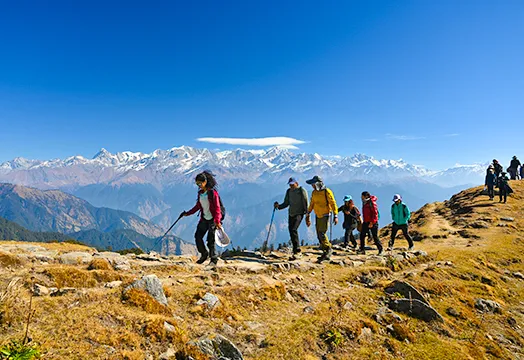
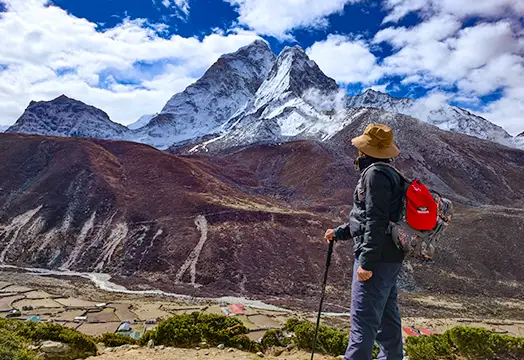
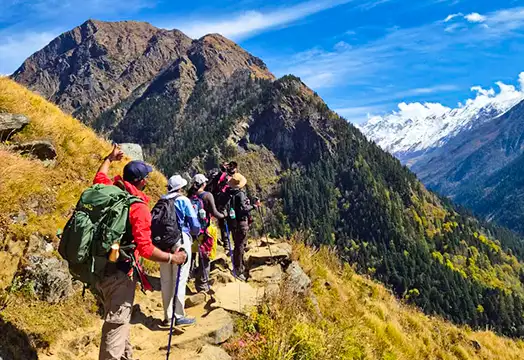
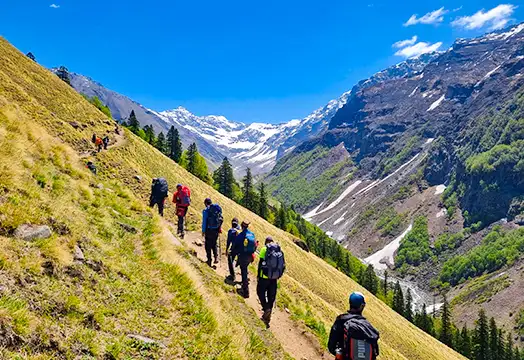
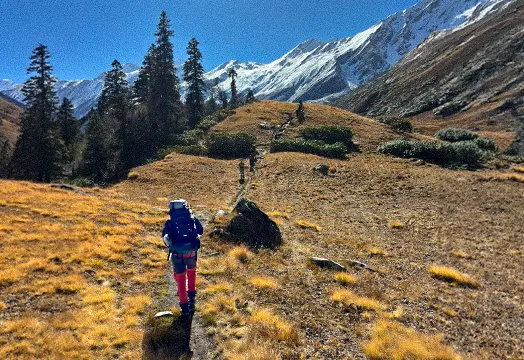
After an hour of unwinding and clicking photos for our memoirs, we started our onward journey. With approximately 10 kgs worth of items in our backpack, it was indeed an arduous 1 Km journey, before we could offload our excess baggage to the mules. Finally, it was just 2-3 kgs in our backpack for the rest of the trek. On this day it was a 6 km walk which was mostly uphill. However, we were kept energised by the sight of rhododendron trees bursting with beautiful blood-red blooms, small and big streams criss crossing our path, cool weather and the general excitement of the trek. Mother Nature was generous and shared its bounty with us…. the stream waters were glacier fed and so fresh and pure that we could drink water directly from them and we even snacked on the rhododendron flowers! For us urbanites, it was indeed therapeutic. After a couple of hours, we had to cross a fast-flowing stream, which had no bridges, just a couple of strategically placed logs. With bated breaths, agile footwork and the use of hiking poles we managed to traverse it, much to our relief. En route, there were small tea shops and there is something magical in the mountains about snacking on Maggi and tea! We too indulged in this mini-meal. Huffing and puffing (but trying not to show it) we carried on our onward journey and it was early evening before we finally spotted a few colourful tents. It was our campsite!
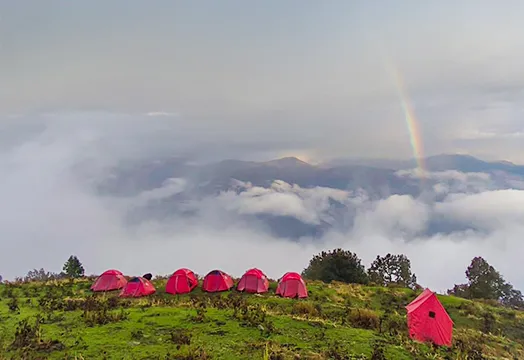
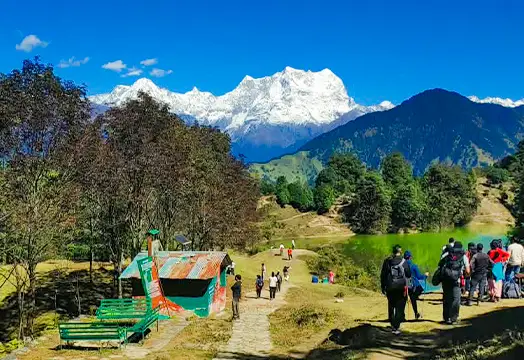
It was as picturesque as one could have imagined it. On one side were the mighty snow-covered Dhauladhars, a huge gushing Nyund River with wildflowers on grassy meadows and the other side was a rocky outcrop sheltering us from the wind. Additionally, there was a naturally formed cave where fresh food was being cooked on firewood for us. The taste of Rajma chawal and tea was an elixir for the soul. Our tent was the size of a double bed and held ground sheets and sleeping bags. It was to be shared by the three of us. We were quite sure that it would not suffice for three adults and our three backpacks (which the mules had carried till here). We were proved wrong that night. With night temperatures hovering at 2-3 degrees and an altitude of about 8000 feet our tents became cosy only because we were 3 of us sharing it. The washroom was a dugout hole in the ground and the primitive way of flushing it was with mud. It was covered by a tent to ensure privacy.
We had envisioned an evening of campfire and singing but alas the weather Gods played spoilsport. Heavy rains followed by hailstorms and howling winds ensured that we took refuge in our tents. Such was the ferocity of the weather that when a stray dog took shelter in our tents between the inner and outer flaps we did not have the heart to chase it away. No electricity, no mobile connections, early dinner in our tents and at 8:00 PM we could have called it a day! However, we chatted at high volumes to drown out the ruckus being created by the weather. Amongst other things, we shared our worries about abandoning our trek if these weather conditions continued. Before finally sleeping, we decided to visit the washroom only to realise that the strong winds had blown away the toilet tent! Early the next day it was found and pitched again by our guides. Tiredness, the snug sleeping bags and clean, pure air guaranteed us a good sleep.
Day 2

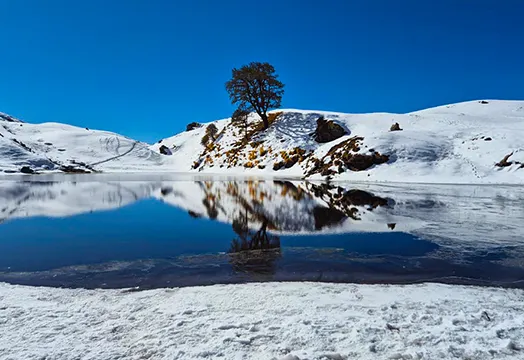
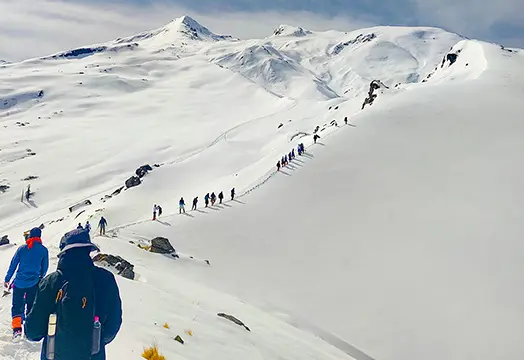
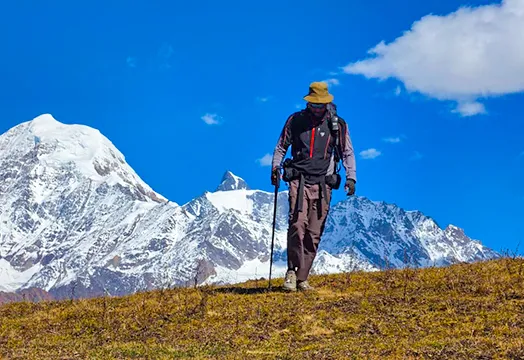
Next morning we were greeted with bright skies and the chirping of the birds. A large number of crimson and black-coloured birds called White Caped Redstarts were enjoying the sunrise with us. The rainwater had drained off and the surroundings gave a freshly bathed appearance. Over a hearty breakfast, we were informed by our guides that today would be a tough day for us as we were to reach an altitude of 9650 feet while doing 7 km uphill. With an hour’s halt at Kareri Lake, we had to trek back 7 km and reach this campsite for a night stay. The difficulty level had increased because of the fresh snow. However, it did not bother us as we all were looking forward to this adventure. We went back to our tents to get dressed for the day. Since the height of the tent was quite low, we learnt the agile art of lying down in the tent to change! We were warmly dressed in layers, which could be added or reduced as per the weather requirements. Once again we set out for our day’s dose of adrenaline. Crossing rivers, walking on narrow paths, now and then plodding on loose snow, sometimes stumbling and getting up, stopping to rest but pretending that the stops were for clicking pics, we covered the initial couple of Kms. Streams and rivers were flowing alongside us and we could spot numerous glaciers as well as snow bridges under which the water was flowing. We met a few other trekkers also and stopped to share notes. By now the path had become snow-covered and the trees were now sparse. The trek guides gave us microspikes to wear over our shoes so that we could form a better grip while walking in the snow. They also shared the technique of putting their toe forward while going uphill and digging in their heels when coming downhill. It was a handy tip because the terrain was mixed. One guide was the leader and another brought up the rear. By now each of us had found a place which was suitable for us and we now took rests without any pretensions. There was no idle chit-chat as we were all conserving our energies. During the difficult parts, we were all there together so that assistance could be provided to each other. Age, social status, gender and fitness level lines were blurred and there was a sense of camaraderie with a shared goal. The 5 Km walk in the snow was a huge challenge for five of us who were first timers for trekking. To add to the confusion there was cold snow beneath our feet and strong sun with a high UV index overhead and we had to decide how warmly we should be clad! Sharing chocolates, nuts and energy drinks the onward journey continued. In the far distance, we glimpsed a Shiva Temple which indicated our destination. With renewed enthusiasm, we pushed forward our tired bodies and by 1 O’clock we finally reached Kareri Lake and Shiva Temple. The lake was frozen and the temple too had about 6-7 feet of snow. The young trekkers of our group went berserk having snow fights and wanting to be clicked bare-chested, reminiscent of Bollywood movies! We enjoyed the light refreshments which our guides had carried for us. It was heartening to see them ensuring that all members carried back their garbage and that we left the place cleaner than we found it. After an hour-long break, we were ready to start our return journey to enable us to reach our campsite by sunset. For part of the journey, many of our team members sat on the snow and just slid down on the slopes for fast movement. It was a little scary as it became difficult to control speed and direction as momentum was gained. By God’s grace, nothing untoward happened. The return journey was quite uneventful as by then we had all mastered the art of traversing in snow. Just a km short of our campsite we had to cross a river. The strong sun of the day had melted the glaciers and that had increased the river volumes to a large extent. It was now impossible to cross as the makeshift log bridge had washed off! The guides were resourceful and they soon created steps using river boulders and holding onto hands as human chains. Our feet did get wet but the river crossing was now manageable. We soon reached our camp and were welcomed by a hot meal and tea. Late evening we did manage to have a small campfire but intermittent showers again made sure that we had an early night.
Day 3

As often happens in mountains, the morning was again cheerfully sunny. The Nylund River flowing 100 m away provided an opportunity for river bathing.
Since this was the last day of the trek and involved only 6 Kms downhill we were in no hurry to get started. Going back to city life after enjoying the beauty of nature was not very appealing. No mobile connectivity helped us connect one to one. When we started conversing it was like peeling an onion, layer upon layer of emotions and the uniqueness of stories emerged. The guides had to coax us to pack up and be on the move. We obliged albeit unwillingly. The downhill descent was easy after the difficult trek of the previous day. We had a good time and in 3 hours we were back in Kareri Village. Water flowing from taps, toilets which flushed and mobiles that worked seemed like luxuries to enjoy. Getting in touch with our loved ones was poignant. Hot lunch feast followed by a 2-hour drive back to Dharamshala and it was time to bid adieu to our family of friends. It was an emotional moment for all of us and we promised to be in touch for more such adventurous sojourns.
Malavika and I carried on to Yol camp, a beautiful cantonment town where we spent the next 24 hours. After luxurious hot water baths and sleeping on proper beds, our return to civilization seems complete. The next day we had friends in Yol to chat with who guided us about the tourist attractions. We decided on a relaxed itinerary. Our sightseeing included a visit to Gyuto Tantric Monastery where young boys are given the training to become monks and to Chinmaya Tapovan where religious discourses and classes on Hindu spirituality are held. Both these religious places are set in a calm and serene environment with a backdrop of Dhauladhars. There is so much peace and tranquillity here that it becomes clear why people seek and find the meaning of life here. Our trip was rounded off by a visit to Norbulingka Institute which is a unique establishment dedicated to the preservation of Tibetan Art and culture. The studios located there offer workshops in thangka art, appliqué work, wood carving and painting. After that, we just chilled out in the quaint and quirky eateries dotting the adjoining area.
In the words of Anthony Bourdain, “Travel isn’t always pretty. It isn’t always comfortable. Sometimes it hurts; it even breaks your heart. But that’s ok. The journey changes you. It leaves marks on your memory, on your consciousness, on your heart and your body. You take something with you. Hopefully, you leave something behind.”
Our holiday was now complete and it was time to depart. We carried with us memories of shared adventures from Kareri Lake Trek. We left behind the lassitude of urban life. There had been difficulties and we discovered that we had the strength to surpass them. Nature’s beauty and bounty had captivated us and with bated breath, we now await the next bracing adventure.